A day and a bit to come home
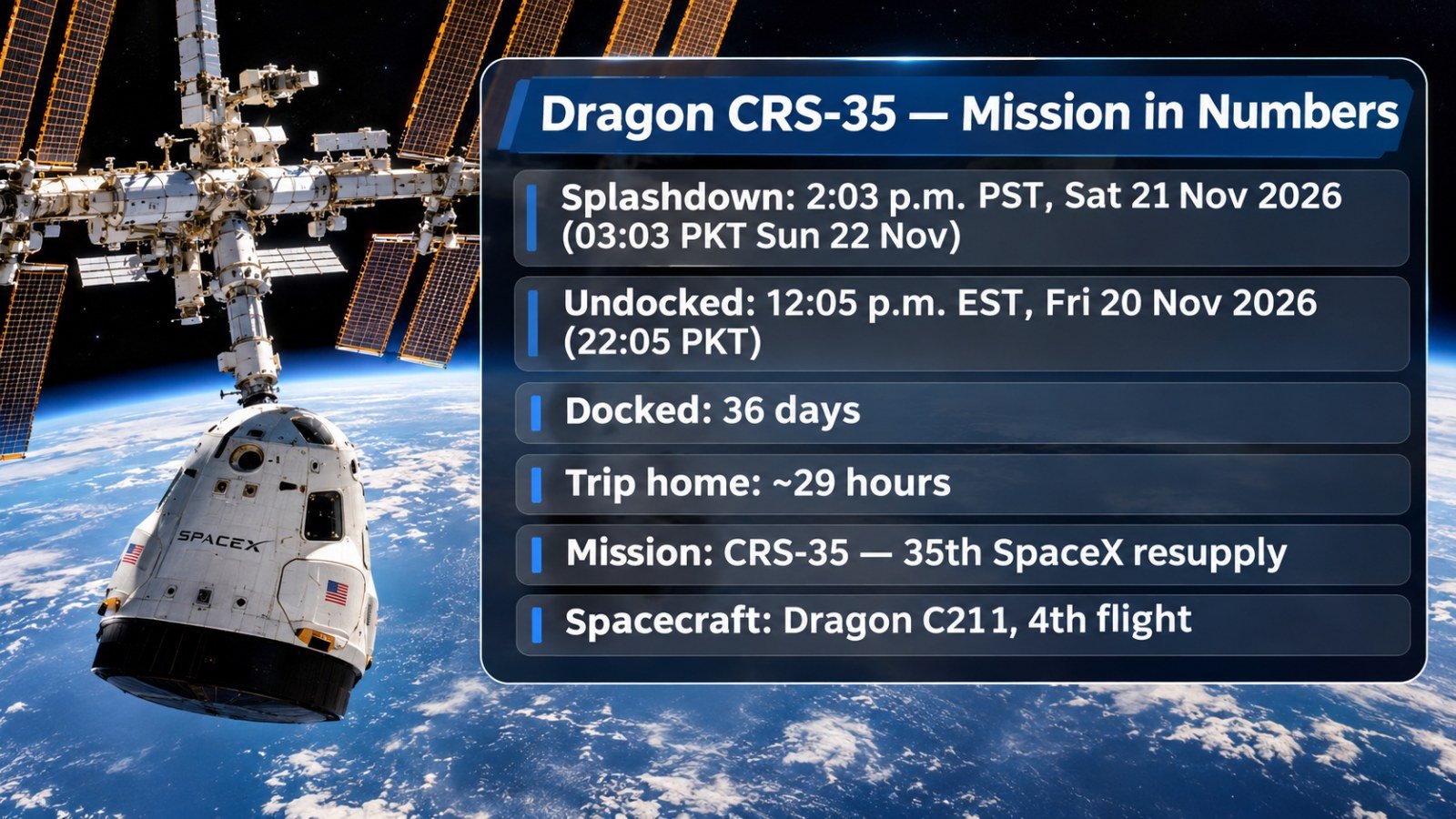
Dragon left the station on Friday. It undocked from the space-facing port of the Harmony module at 12:05 p.m. EST — 22:05 in Pakistan — on a command from SpaceX ground controllers, and then spent roughly 29 hours making its way back to Earth.
The departure itself had been a long time coming. Bad weather off the California coast forced NASA and SpaceX to call off two earlier undocking attempts, on Wednesday and Thursday, before Friday's third try went ahead on schedule.
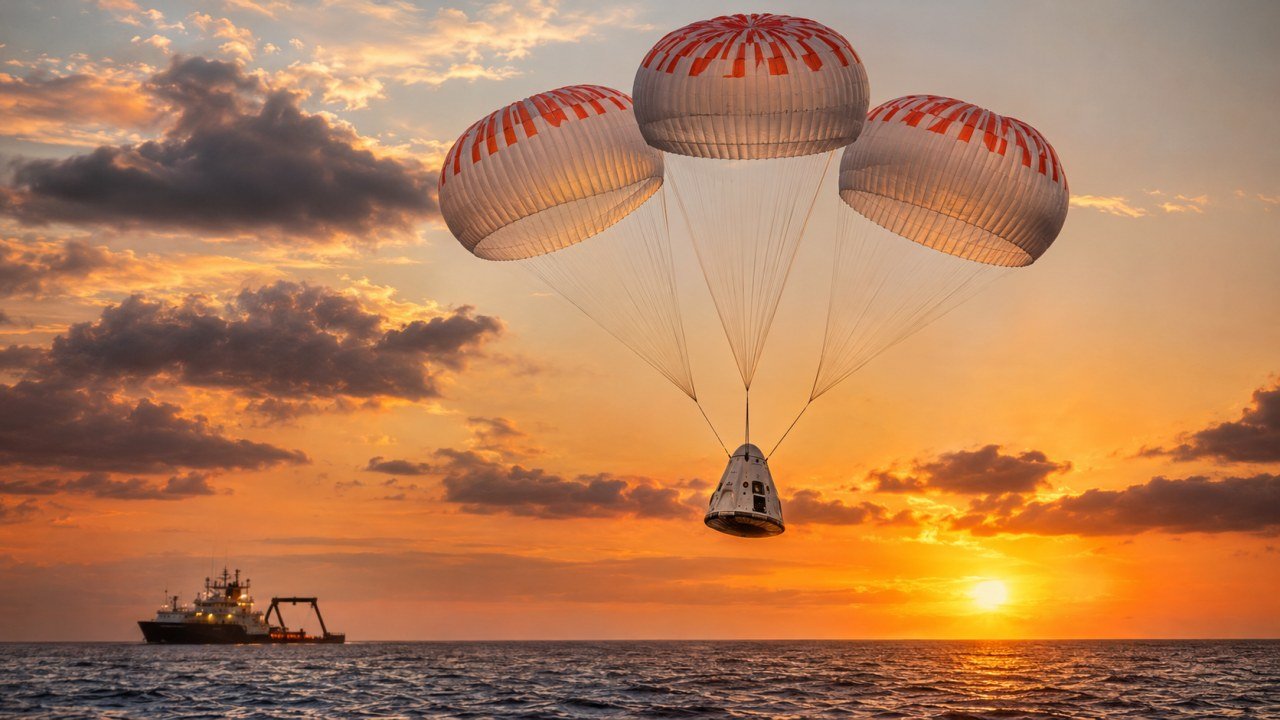
Saturday's splashdown ran eight minutes later than the time NASA had originally targeted — 4:55 p.m. EST — but that is normal for a returning capsule. The exact moment depends on the final deorbit burn, the re-entry and the parachute descent, and all of it went as planned.
There were no live pictures of the landing. NASA did not stream the splashdown, and updates arrived on the space station blog instead. SpaceX had said beforehand that people along the Southern California coast might hear a brief sonic boom as the capsule came down, just before it hit the water.
What's in the hold
The return cargo is the reason this flight matters as much as the delivery that brought Dragon up in the first place. A cargo capsule is, in effect, a flying laboratory fridge: it carries samples back that lose their value if they stay in orbit too long, and scientists on the ground are often waiting at the recovery site to collect them.
This time the list reads like a hospital laboratory. There is a 3D-bioprinted blood vessel, grown in orbit to study how blood vessels age and how cardiovascular disease develops — in space and on Earth. There are frozen tumor organoids, tiny lab-grown tumor models that were treated aboard the station, which researchers hope will point to better cancer treatments and more personalized medicine. And there are frozen microbial samples, sealed up so scientists can work out how antibiotic-resistant bacteria survive, adapt and evolve in weightlessness.
A lighting system is also on board, after more than three years on the station. Researchers have been testing whether tuned light can help astronauts sleep properly on long-duration missions — a small thing on Earth, and a real problem in orbit, where the sun rises and sets sixteen times a day.
Alongside the science travels a piece of station hardware with a story of its own: the failed wrist joint from Canadarm2, the station's robotic arm. The joint failed in May 2026, and the crew replaced it during a spacewalk on 30 June. Astronaut Jessica Watkins packed the failed joint for the trip home, and engineers want to take it apart on the ground to find out exactly what went wrong.
The spacecraft and the mission so far
The Dragon flying this mission is C211, and it is no stranger to the station. This is its fourth flight — the same capsule previously flew the CRS-26, CRS-29 and CRS-33 cargo missions.
It launched on 13 October 2026 aboard a Falcon 9 rocket from Space Launch Complex 40 at Cape Canaveral Space Force Station in Florida, and docked to the Harmony module two days later, on 15 October.
On the way up, Dragon delivered more than 6,300 pounds of science and supplies. Among that cargo was the final pair of roll-out solar arrays, which completed the station's power upgrade — a milestone in its own right, and one we covered when the arrays were installed.
That is the shape of this mission: a major delivery on the way up, and a hold full of experiments and hardware on the way down. Once the capsule is fished out of the Pacific and its cargo is handed to the waiting scientists, the work of CRS-35 moves from orbit to the laboratory — and the results, over the coming months, are what the whole trip was for.
Frequently Asked Questions
When did SpaceX's Dragon splash down after leaving the ISS?
Dragon splashed down in the Pacific Ocean near Los Angeles at 2:03 p.m. PST on Saturday, 21 November 2026 — 5:03 p.m. EST, or 03:03 PKT on Sunday, 22 November.
How long was Dragon docked to the International Space Station?
Dragon was docked for 36 days, from 15 October 2026 to 20 November 2026, when it undocked at 12:05 p.m. EST (22:05 PKT).
Did NASA stream the splashdown?
No. NASA did not stream the splashdown; updates were posted on the NASA space station blog, and SpaceX confirmed the landing on X at 2:04 p.m. PST.
What science did Dragon bring back to Earth?
Dragon returned a 3D-bioprinted blood vessel construct, frozen tumor organoids treated aboard the station, frozen microbial samples, a circadian lighting system after more than three years aboard, and the failed Canadarm2 wrist joint, which was replaced on 30 June 2026 and packed by astronaut Jessica Watkins.
Which Dragon flew the CRS-35 mission?
Cargo Dragon C211, on its fourth flight. It previously flew the CRS-26, CRS-29 and CRS-33 missions.
Sources
NASA — Space Station blog, Mark A. Garcia, "Dragon Returns to Earth Packed With Science and Cargo" (November 21, 2026).
NASA — Space Station blog, "Dragon Undocks from Station Packed With Science and Cargo" (November 20, 2026).
SpaceX on X — splashdown confirmation (November 21, 2026, 2:04 p.m. PST).
Related reading
Dragon Has Left the Station: SpaceX Cargo Capsule Undocks After 36 Days, Splashdown Early Sunday — ISS Tracker
Dragon Leaves Tonight: How to Watch the SpaceX Cargo Capsule Undock at 22:05 PKT — ISS Tracker
ISS Completes Final Solar Array Upgrade: Power Jumps to 215 Kilowatts — ISS Tracker