ISS Tracker › Space News › How Do Astronauts Exercise on the International Space Station?
Guide
How Do Astronauts Exercise on the International Space Station?
Two hours a day, every day: how astronauts fight muscle and bone loss in weightlessness with a treadmill, a space bike and a weight machine that uses no weights at all.
By Stephen Carter · November 18, 2026
On Earth, your body gets a workout just by standing up. Gravity pulls on your bones and muscles all day, every day, and that constant load is what keeps them strong. Take gravity away — as the International Space Station does — and the body starts to quietly fall apart.
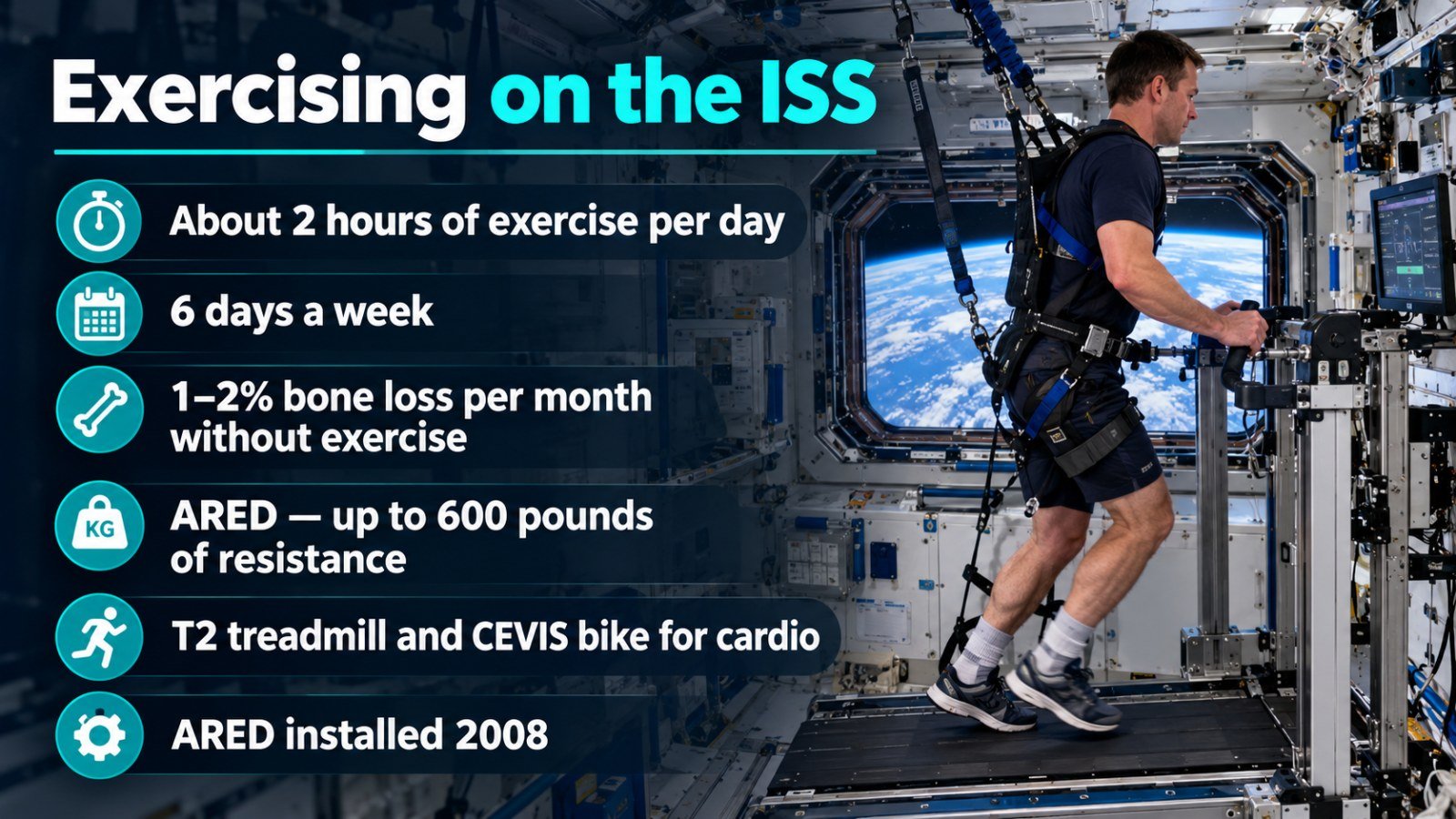
That is why exercise on the ISS is not a hobby or a way to pass the time. It is medicine. Astronauts work out for about two hours a day, six days a week, on equipment built specifically for weightlessness, and the routine is one of the most important parts of living in orbit.
What weightlessness does to a body
Without gravity, the large postural muscles in the legs and back no longer have to hold the body upright, so they weaken and shrink. Without regular exercise, astronauts can lose up to 20 percent of their muscle mass on flights lasting just five to eleven days.
Bones suffer in a similar way. Bone builds and maintains itself in response to the stress of carrying weight. Remove that stress and bones shed calcium, losing roughly 1 to 2 percent of their density every month — fastest in the hips, lower back and legs. Over a six-month mission, that can add up to more than 10 percent in the hardest-hit areas, a rate of loss similar to osteoporosis on Earth.
The heart is affected too. In weightlessness the heart does not have to pump blood uphill against gravity, so it weakens and shrinks slightly, and aerobic capacity — measured as VO2max, the maximum amount of oxygen the body can use — drops measurably during long missions. Even with today's exercise programme, fitness losses can still occur, which is why NASA keeps refining the routine.
The station's gym: three machines
The ISS gym is small — essentially three pieces of equipment, each adapted in a clever way for a place where nothing weighs anything.
ARED — the weight machine with no weights. The Advanced Resistive Exercise Device, installed in 2008, is the cornerstone of the programme. Since iron plates are useless in weightlessness, ARED uses vacuum cylinders and a flywheel system to create resistance of up to 600 pounds. Astronauts use it for squats, deadlifts, bench presses and calf raises — the heavy, load-bearing movements that protect the bones and muscles of the lower body. A European Space Agency study called ARED Kinematics is still analysing how this kind of exercise affects the body in microgravity, to help design better workout programmes for future missions.
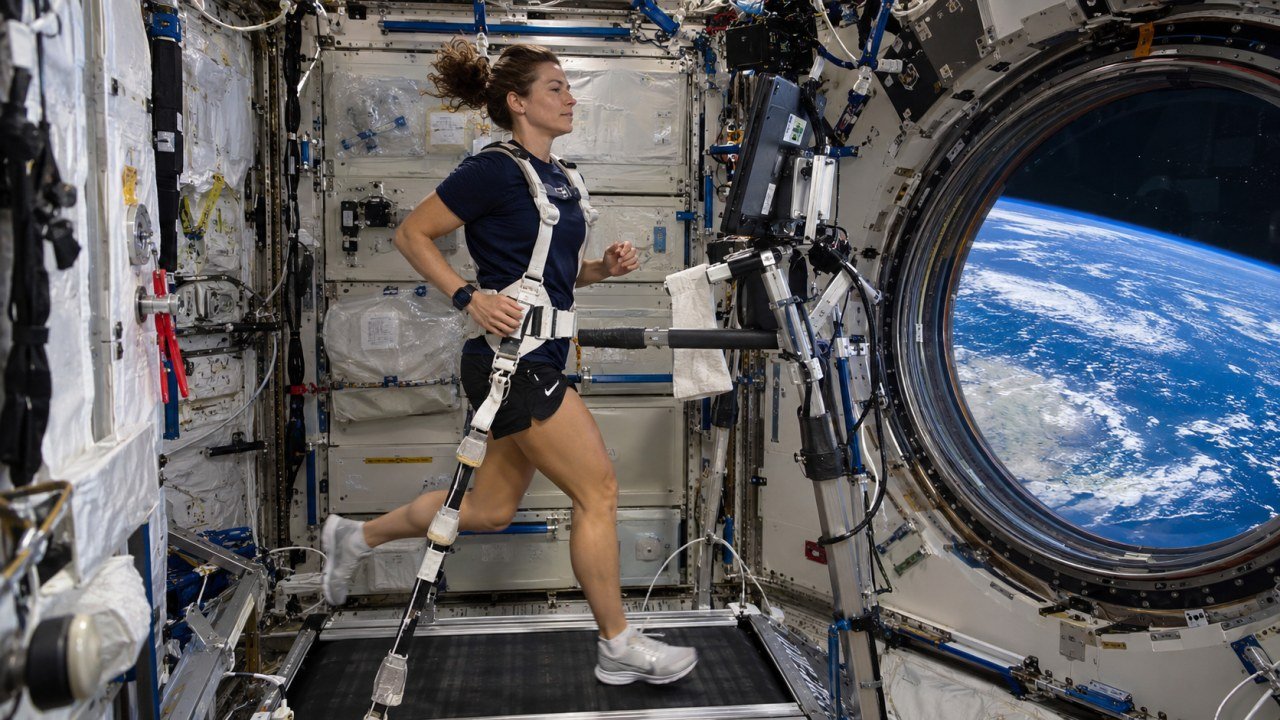
T2 — the treadmill you cannot fall off. Running inspace has an obvious problem: one good stride and you would float away. So astronauts strap themselves to the T2 treadmill with a bungee-cord harness that pulls them down onto the belt, letting them run or walk while staying in place. The T2 is officially the Combined Operational Load Bearing External Resistance Treadmill — a name chosen after a 2009 public poll to name a station module. NASA named the module Tranquility and gave the comedian Stephen Colbert's name to the treadmill instead, which is why it is known as COLBERT.
CEVIS — the space bike. The Cycle Ergometer with Vibration Isolation and Stabilization System is a stationary bicycle, installed in 2001 and upgraded in 2023. Astronauts strap their feet into the pedals and ride anything from a steady endurance session to high-intensity intervals. It is the main tool for keeping the heart and circulation fit — and many astronauts say it is the toughest part of the workout.
A typical training day
A standard session mixes the two kinds of work: resistance training on ARED, then cardio on the treadmill or the bike. The split matters, because each protects something different — resistance for bone and muscle, cardio for the heart and lungs.
Research on the station has changed how that time is used. Early crews exercised at low intensity for long periods, sometimes up to ten hours a week, and still lost muscle and bone. A NASA study called Sprint compared that approach with shorter, higher-intensity sessions and found the harder, shorter workouts protected fitness better. Today's routine reflects that lesson.
New equipment is still being tested. In November 2026 the Expedition 75 crew tried out a new exercise device known as E4D, part of NASA's ongoing work to find lighter, better countermeasures for the longer missions ahead — to the Moon, and eventually to Mars, where there will be no quick trip home if a crew member's body breaks down.
Coming back down
Exercise does not prevent every change, and the first days back on Earth are the proof of it. Returning astronauts are wobbly on their feet, their balance is off, and simple things like standing up for long periods feel strange. They go through weeks of supervised reconditioning — physical therapy, graded exercise, balance work — before their strength and bone density return to normal.
That is the other reason the two hours a day matter. The workout is not only about surviving six months in orbit. It is about arriving home in a body that still works on Earth.
Frequently Asked Questions
How long do astronauts exercise on the ISS each day?
About two hours a day, six days a week, mixing resistance training and cardio.
What exercise equipment is on the space station?
Three main machines: the ARED weight-lifting device, the T2 treadmill and the CEVIS cycle ergometer. A new device, E4D, was tested by the Expedition 75 crew in November 2026.
Why do astronauts need to exercise in space?
Without gravity, muscles weaken and bones lose density — about 1 to 2 percent of bone mass per month. Exercise is the main countermeasure, along with diet and monitoring.
Can astronauts run on a treadmill in space?
Yes. They wear a bungee-cord harness that holds them down on the belt of the T2 treadmill, nicknamed COLBERT.
Does exercise fully prevent muscle and bone loss?
No. It slows the loss considerably, but some decline still happens on long missions, and returning crews need weeks of reconditioning on Earth.
Sources
NASA — Astronaut Exercise (ISS Research).
NASA — Space Station blog, "Botany, Biomedicine, and Cargo Ops Wrap Up Week Aboard Station" (November 13, 2026).
Science Friday — Exercise Like An Astronaut!
Related reading
How Do Astronauts Sleep on the International Space Station? — ISS Tracker
What Do Astronauts Eat on the International Space Station? — ISS Tracker
ISS Completes Final Solar Array Upgrade: Power Jumps to 215 Kilowatts — ISS Tracker
Source note: This article is an independent summary of public space-agency information. Readers can verify the mission facts using the original source cited in the article.