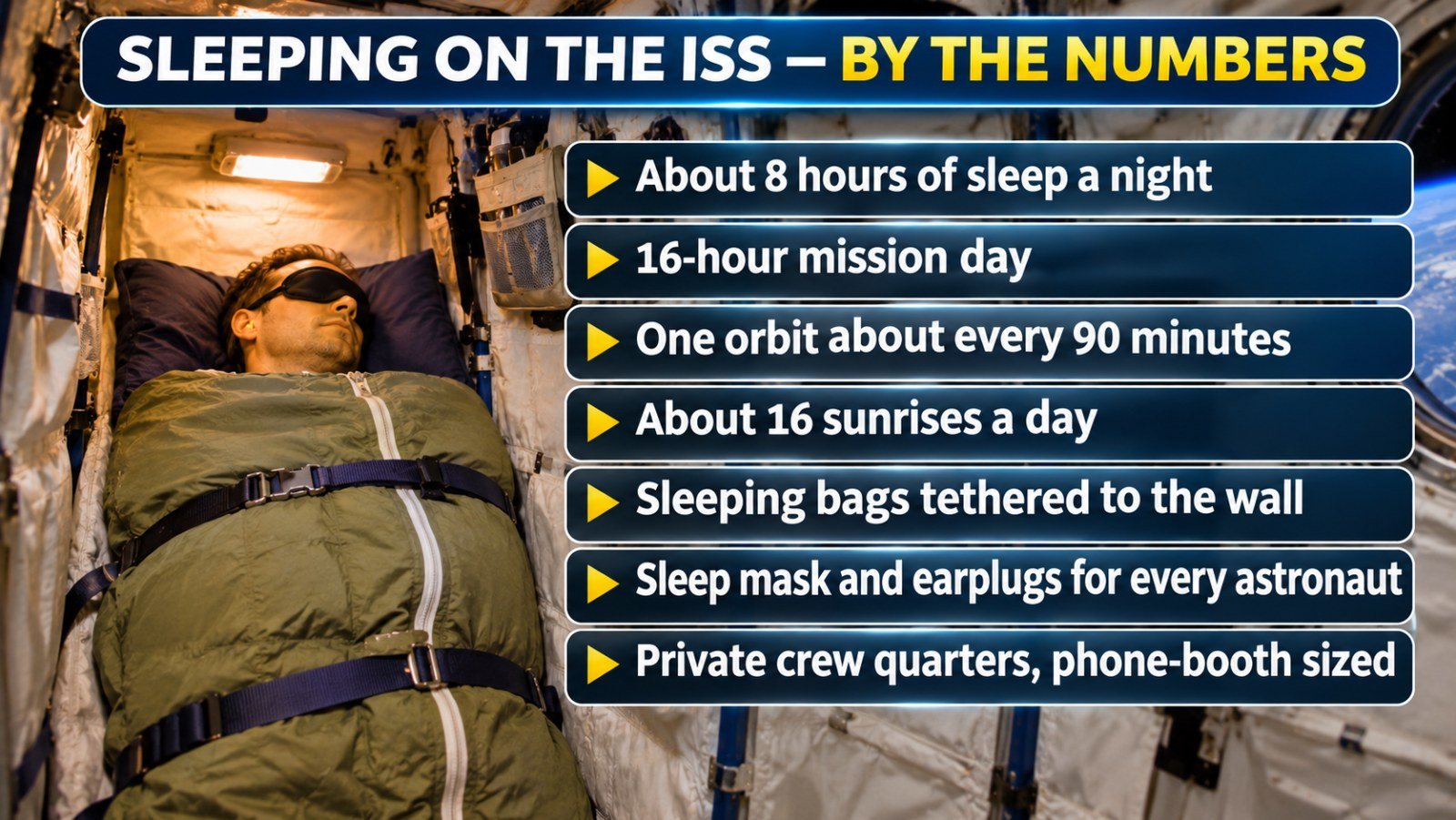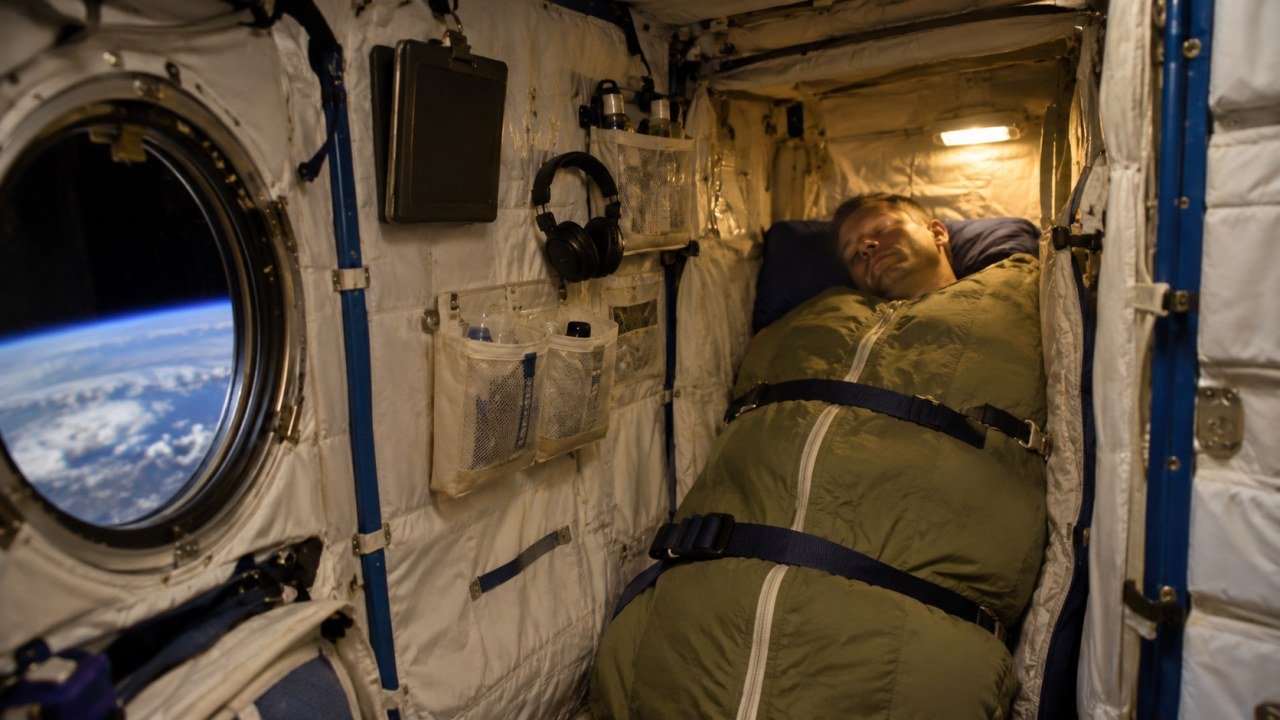
Sleep is the most ordinary thing astronauts do in space, and also one of the strangest. There is no bed to climb into, no mattress, and no real night. There is a sleeping bag, a wall to strap it to, a compartment barely bigger than a phone booth, and a Sun that rises sixteen times a day.
And yet the crew sleeps. About eight hours a night, on a schedule, like the rest of us — just with considerably more Velcro involved.
A bedroom the size of a phone booth
The station does not have bedrooms in any normal sense. What it has is crew quarters: small, private compartments where each astronaut can shut themselves away from the rest of the crew. They are roughly the size of a phone booth, and there is not much in them beyond a sleeping bag and a few personal items.
That sounds cramped, and it is. But after a 16-hour day spent sharing every corridor, laboratory and meal table with six other people, a tiny room of your own is not a hardship — it is a relief. Privacy is the luxury here, not space.
The quarters close off from the rest of the station, and they have covers to shut out the light. That matters more than it sounds, because outside the walls the Sun is rising and setting every 45 minutes or so.
Strapped in, not tucked in
On Earth, gravity does half the work of sleeping for you. It holds you on the mattress, keeps your head on the pillow, and keeps your arms by your sides. Take gravity away and none of that holds.
So astronauts sleep inside sleeping bags that are attached to a wall or a seat. The bag is the bed, the wall is the floor, and the straps are what stop the sleeper from drifting gently across the cabin in the middle of the night and bumping into equipment. NASA's own advice is blunt about it: strap yourself down, or you will float away.
There is no up or down inside the station, which means there is no "right way up" to sleep in. An astronaut can be vertical, horizontal, or upside down relative to the rest of the crew, and it makes no difference at all. What does need managing is the arms. On Earth they rest on the bed; in weightlessness they float away from the body unless they are tucked inside the sleeping bag.
A pillow is not doing the job it does at home, because there is no gravity pulling your head down onto it — though some astronauts still keep a small one for comfort, and the sleeping bags themselves have enough padding to feel less like camping on a wall.
Sixteen sunrises a day
This is the part that would break most people's sleep first. The station circles Earth about every 90 minutes, so the crew sees roughly 16 sunrises and 16 sunsets in a single day. Darkness on the ISS is not a time of day. It is a 45-minute stretch that keeps interrupting itself.
Nobody could sleep by the Sun under those conditions, so nobody tries. The crew sleeps by the clock: a 16-hour working day, then about eight hours set aside for sleep, the same hours every day, whether the Sun is up, down, or up again. The routine is the night.
It works, mostly. The station's lighting was designed with this in mind, and the crew quarters shut out what light they can. But a schedule is still doing the job that sunset does for the rest of us.
What can go wrong with sleep in space
Two things, mainly: light and noise. The station never really goes quiet. Fans, pumps and equipment hum around the clock, crewmates work different shifts, and something is always beeping somewhere. Each astronaut gets a sleep mask and earplugs, and they are not optional extras — they are part of the kit, issued to everyone, because blocking out the station is the only way to get a proper night's rest.
The mask handles the sixteen sunrises. The earplugs handle the hum. The sleeping bag handles the floating. None of it is elegant, and none of it is comfortable in the way a bed at home is comfortable. But it is a system that has kept people sleeping in orbit for more than twenty-five years, and the crew gets used to it — most astronauts say they sleep well once they settle into the routine.
That is the honest truth about sleeping in space. It is not the floating peacefully among the stars of the movies. It is a zipped-up bag, a dark mask, earplugs, and a timetable. And it works.
FAQ
How many hours do astronauts sleep on the ISS?
Typically about eight hours, after a 16-hour mission day.
Do astronauts sleep in ordinary beds?
No. They sleep in sleeping bags attached to a wall or a seat, so they stay in one place instead of floating around the cabin.
Do astronauts have private bedrooms?
They have small private sleeping compartments called crew quarters, roughly the size of a phone booth, holding little more than a sleeping bag and a few personal items.
Do astronauts need pillows in space?
Not in the way we do on Earth — with no gravity pulling the head down, a pillow has nothing to push against. Some astronauts still keep a small one for comfort.
How do astronauts sleep when the Sun keeps rising?
They sleep by the clock, not by daylight. The station orbits Earth about every 90 minutes, giving about 16 sunrises a day, so the crew follows a fixed schedule and uses sleep masks and covers to block the light.
Sources
- NASA, Living and Working in Space — eight hours of sleep after a 16-hour mission day; sleeping bags attached to a wall or seat; sleep masks and earplugs issued to every astronaut
- Smithsonian National Air and Space Museum, How Do Astronauts Sleep in Space? — crew quarters the size of a phone booth; sleeping in weightlessness
Related reading
- How Fast Does the ISS Travel? Speed, Orbit and 16 Sunrises a Day
- How Do Astronauts Exercise on the International Space Station?
- What Do Astronauts Eat on the International Space Station?
- Can You See the ISS From Earth? How to Spot the Space Station