There was nobody on board when the rocket left Baikonur on Tuesday afternoon. No crew, no countdown chatter from a capsule, just a freighter full of food, fuel and supplies climbing into the sky on a Soyuz rocket, bound for the International Space Station.
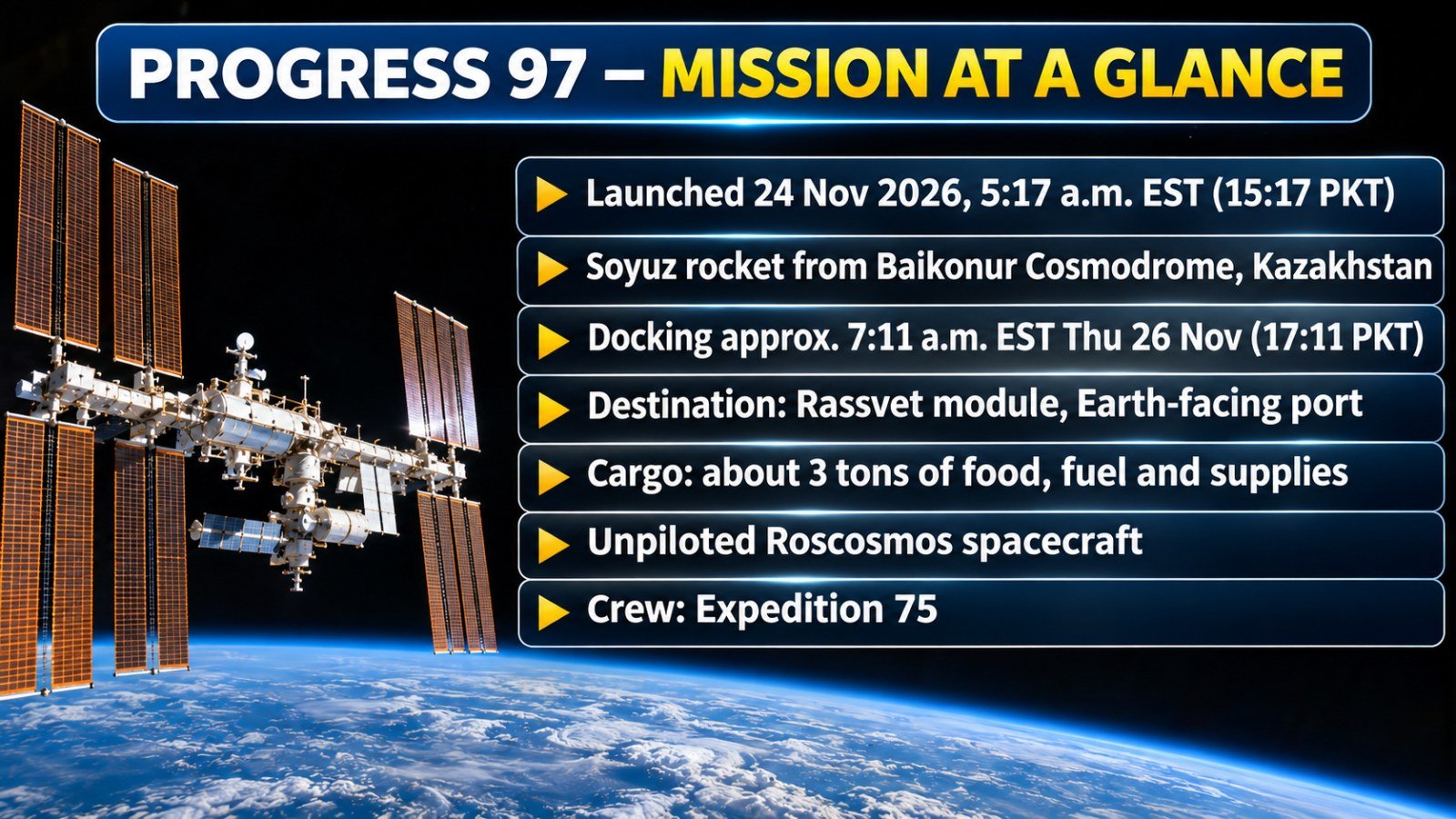
That is how most of the station's shopping gets done. The unpiloted Roscosmos Progress 97 cargo spacecraft launched at 5:17 a.m. EST on Tuesday, 24 November 2026 — 15:17 in Pakistan — and it is now in orbit, chasing the station down for a docking planned on Thursday.
The launch
The launch itself was routine, which is exactly what you want from a cargo run. A Soyuz rocket carried Progress 97 away from the Baikonur Cosmodrome in Kazakhstan, and within minutes the spacecraft was safely in orbit and on its way.
Progress freighters have been doing this job for decades. They are not glamorous — nobody is taking photographs from inside one — but without them the station simply runs out of things. Food, water, air, fuel, spare parts, fresh clothes, science gear: all of it arrives on unpiloted ships like this one, because sending a crewed spacecraft every time the crew needs groceries would be absurdly expensive.
The trip takes about two days. Progress 97 will spend that time gradually closing the gap with the station, making small engine burns to match its orbit, before lining up for the final approach.
What is Progress 97 carrying?
About three tons of it, according to NASA: food, fuel and supplies for the Expedition 75 crew.
Three tons sounds like a lot until you remember what it has to cover. Seven people live and work on the station around the clock, and everything they eat, drink and breathe has to be shipped up from Earth. There is no corner shop at 400 kilometres up, and there is no popping out for a forgotten item.
The fuel matters just as much as the food. Some of it tops up the station's own propellant reserves, and Progress freighters can also fire their engines while docked to nudge the whole station a little higher — a reboost — countering the slow drag of the thin air up there. We explained why the station needs that constant push in our earlier article, How Fast Does the ISS Travel?
When it docks — and how to watch
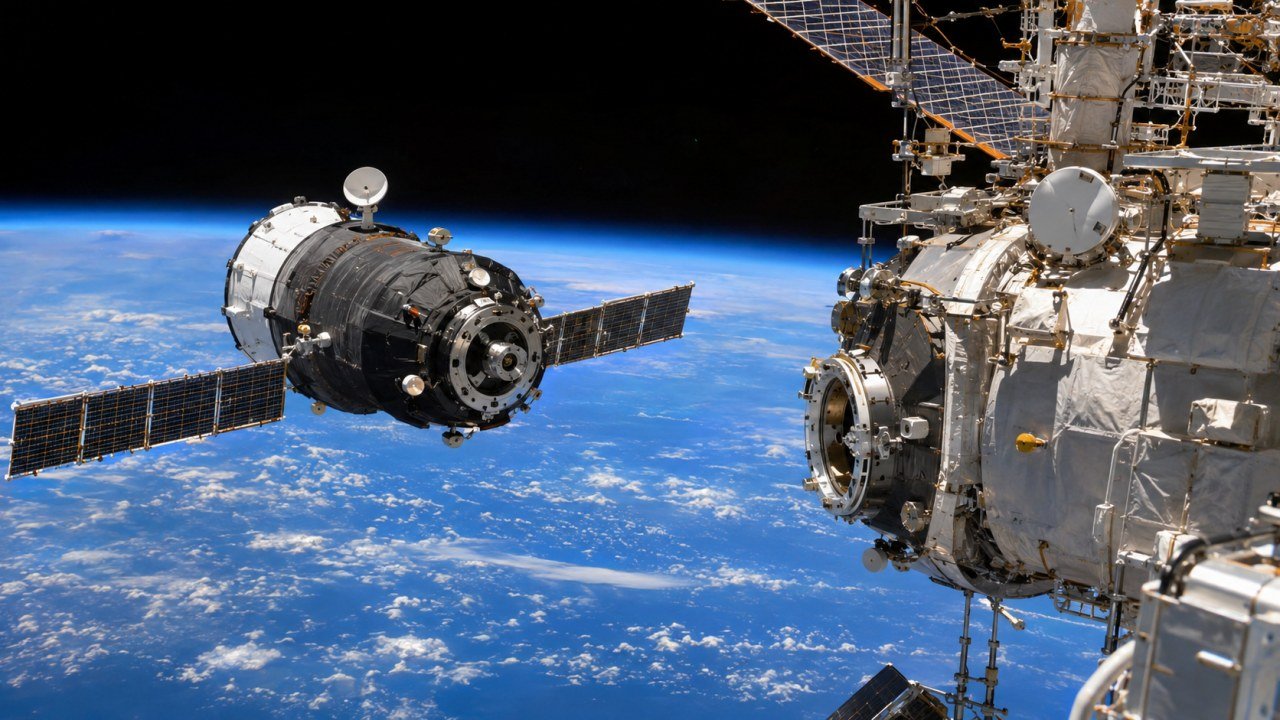
Progress 97 is scheduled to dock by itself at approximately 7:11 a.m. EST on Thursday, 26 November — 17:11 PKT — at the Earth-facing port of the station's Rassvet module.
Autonomous docking means nobody flies it in by hand. The spacecraft's own computers guide it to the port and make the connection, while flight controllers in Moscow and Houston watch the telemetry. It is a well-practised manoeuvre, but it is still the tensest part of the mission: a freighter arriving at the wrong speed or the wrong angle is a problem nobody wants.
NASA will stream the arrival live from 6:30 a.m. EST (16:30 PKT) on Thursday at nasa.gov/live, so anyone can watch the final approach and the moment of contact.
Why these cargo runs matter
It is easy to treat a cargo launch as background noise between the crewed missions that get all the attention. That misses the point. The station has been continuously occupied for more than a quarter of a century, and the only reason that is possible is a steady, unglamorous supply line: Progress freighters from Russia, Dragon capsules from SpaceX, and other cargo ships taking turns.
Each one is also a small piece of international cooperation. Progress 97 is a Russian spacecraft, launched from Kazakhstan, docking with a station whose crew includes NASA and Canadian astronauts — and NASA is streaming its arrival for the world to watch. The politics of spaceflight may be complicated, but the supply line is not: the crew needs food, and the freighter brings it.
For the Expedition 75 crew, Thursday's docking means fresh supplies and a little more breathing room. For the rest of us, it is a reminder of how the station actually stays alive — not by grand gestures, but by regular deliveries, on time, two days after launch.
FAQ
What is Progress 97?
An unpiloted Roscosmos cargo spacecraft, launched on a Soyuz rocket from the Baikonur Cosmodrome in Kazakhstan. It carries food, fuel and supplies to the International Space Station — no astronauts aboard.
When did Progress 97 launch?
At 5:17 a.m. EST on Tuesday, 24 November 2026 (15:17 PKT).
When will Progress 97 dock with the ISS?
It is scheduled to dock autonomously at approximately 7:11 a.m. EST on Thursday, 26 November 2026 (17:11 PKT), at the Earth-facing port of the Rassvet module.
Where can I watch the docking live?
NASA's live coverage begins at 6:30 a.m. EST (16:30 PKT) on 26 November at nasa.gov/live.
How much cargo is Progress 97 carrying?
About three tons of food, fuel and supplies for the Expedition 75 crew.
Sources
- NASA Space Station blog, 24 November 2026 — Progress Cargo Craft Lifts Off to Resupply Expedition 75 Crew (launch time, docking time and place, cargo, live coverage)
Related reading
- Dragon Is Home: SpaceX Cargo Capsule Splashes Down Off California, Ending the CRS-35 Mission
- How Fast Does the ISS Travel? Speed, Orbit and 16 Sunrises a Day
- How Big Is the ISS?
- Can You See the ISS From Earth? How to Spot the Space Station