ISS Tracker › Space News › What's Inside Cygnus XL? The Science Flying to the ISS on Sunday
Space News
What's Inside Cygnus XL? The Science Flying to the ISS on Sunday
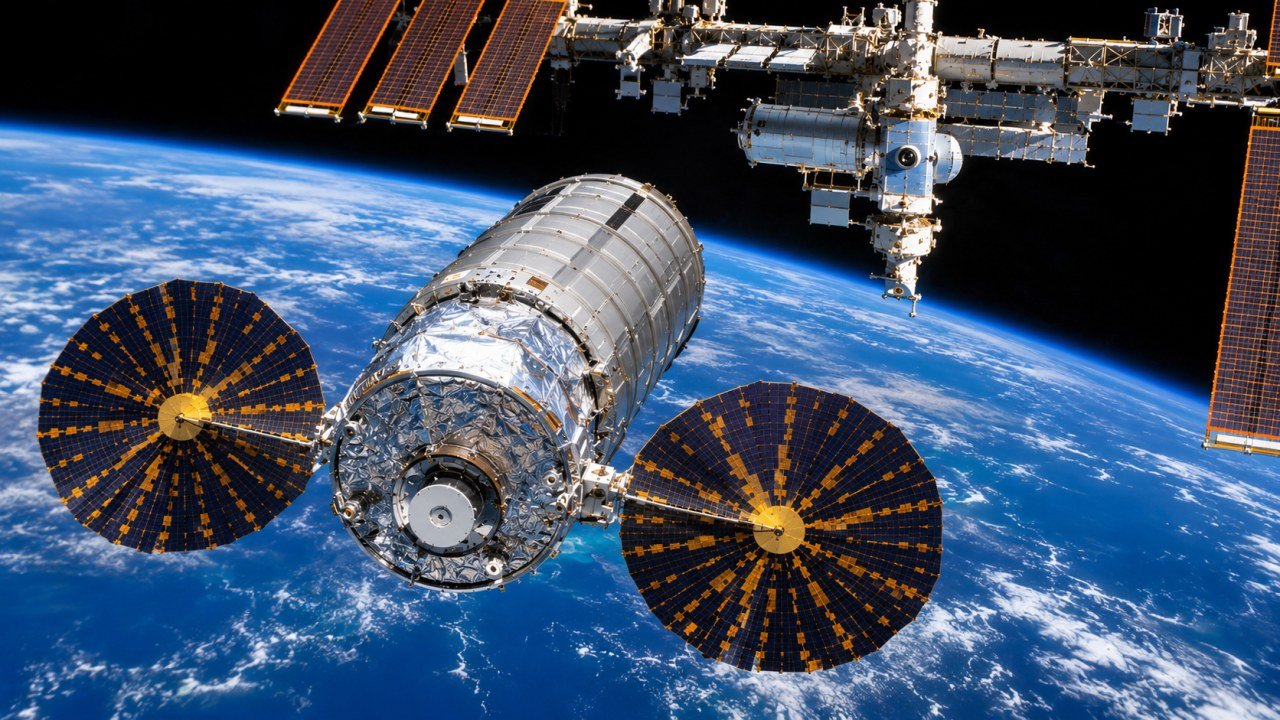
Cygnus XL launches Sunday 29 November with about 11,000 pounds of cargo — including five experiments on muscle loss, cancer, drug delivery, radiation and growing food in space.
By Stephen Carter · November 28, 2026
Sunday's launch is about more than supplies. Yes, Cygnus XL is carrying food and spare parts to the International Space Station. But the interesting half of its load is science — five experiments that can only be run properly without gravity, and that could matter as much in a hospital on Earth as they do in orbit.
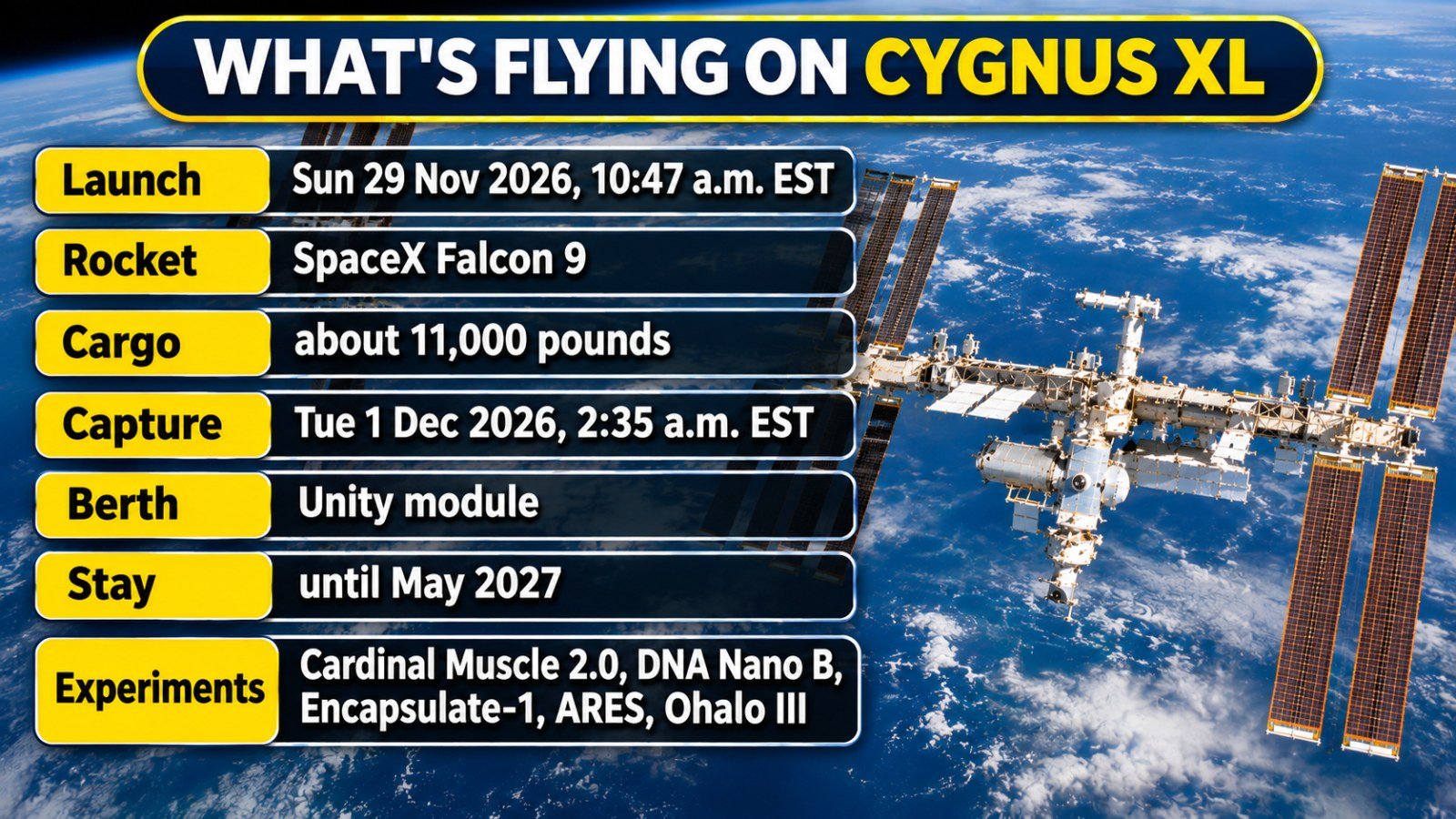
The spacecraft lifts off no earlier than 10:47 a.m. Eastern time on Sunday, 29 November — 8:47 p.m. in Pakistan — on a SpaceX Falcon 9 from Cape Canaveral in Florida. It is the final cargo mission of 2026, and it is carrying about 11,000 pounds in total.
Here is what is inside, and why each experiment is flying.
Cardinal Muscle 2.0: fighting muscle loss
Ask any astronaut what space does to the body, and muscle loss is near the top of the list. Without gravity to push against all day, muscles weaken fast — far faster than they do in a person who simply stops exercising.
Cardinal Muscle 2.0 tackles that problem with engineered muscle tissue grown in the laboratory. The experiment tests whether drugs already approved by the U.S. Food and Drug Administration for other conditions could be repurposed to slow down or prevent muscle loss.
That last part is the clever bit. Developing a brand-new drug takes years. Finding a new use for one that is already approved and already known to be safe is much quicker. And the payoff is not only for astronauts: muscle loss in space shares many features with the muscle decline that comes with ageing on Earth. A treatment that works in orbit could one day help older people stay stronger for longer.
DNA Nano B: tiny carriers for medicine
Some of the hardest places to deliver medicine in the human body are the dense tissues — cartilage, and solid tumours. Drugs struggle to get in.
DNA Nano B tries a different route. It uses microgravity to manufacture tiny particles inspired by DNA, designed to carry medicine deep into those tissues. Making them in space matters because, without gravity pulling the ingredients one way, the particles can assemble more evenly than they do on Earth.
If it works, the result could be more precise treatments for cancer and osteoarthritis — medicine that reaches the right spot instead of flooding the whole body.
Encapsulate-1: watching cancer spread
Encapsulate-1 grows miniature replicas of real patients' tumours, then watches how the cancer cells inside them move, push into the tissue around them, and spread.
The goal is a diagnostic test that could predict whether a cancer is likely to progress — months or even years ahead. That kind of warning would change how doctors and patients plan treatment.
Studying the tumour replicas in weightlessness may reveal details about cancer growth that gravity hides on Earth. It is early-stage research, and nobody is promising a cure. But understanding how cancer moves is the first step to stopping it.
ARES: measuring radiation for the Moon
Space is full of radiation, and the further crews travel from Earth, the more of it they face. The station sits inside Earth's magnetic field, which offers some protection. The Moon does not.
ARES — the Active Radiation Environment Sensor — is a small device that monitors radiation levels in the areas where the crew live and work. The readings it collects will help NASA plan radiation monitoring and crew safety for Artemis missions to the Moon.
Small box, big job: it is one of the pieces of homework the station is doing for the crews who will travel farther from Earth than anyone has in more than fifty years.
Ohalo III: growing food in space
Sooner or later, astronauts going to the Moon or Mars will have to grow their own food. Deliveries from Earth will be too slow, too rare, or simply impossible.
Ohalo III is a step towards that. It is a new, mostly automated plant growth facility — NASA describes it as a first-of-its-kind space crop production system — using water recovery and air exchange technology to give plants what they need to grow.
The point is not a salad. It is proving that a machine can keep crops alive, largely on its own, for months at a time. Fresh food would feed the crew, and it would also give them something green and alive to look at, a long way from home.
A little holiday cheer
Not everything on board is an experiment. Cygnus XL is also carrying fresh fruit and vegetables, gingerbread house kits, holiday cookies, candies and international foods for the crew's holidays.
Seven people, 250 miles up, sharing Christmas cookies sent from Earth. The science is the reason for the flight. The cookies are a reminder of who it is for.
FAQ
When does Cygnus XL launch?
No earlier than 10:47 a.m. Eastern Standard Time on Sunday, 29 November 2026 — 8:47 p.m. Pakistan time — on a SpaceX Falcon 9 from Space Launch Complex 40 at Cape Canaveral Space Force Station, Florida.
What is the spacecraft called?
Cygnus XL, named the S.S. James "Jim" A. Lovell, after the former NASA astronaut who commanded Apollo 13.
When will it arrive at the station?
NASA astronauts Jessica Watkins and Luke Delaney will capture it with the Canadarm2 robotic arm on Tuesday, 1 December 2026, at about 2:35 a.m. Eastern (12:35 p.m. Pakistan time). It will then be installed on the Earth-facing port of the Unity module.
How long will Cygnus XL stay at the station?
Until May 2027. It will then depart carrying several thousand pounds of disposal items and burn up during re-entry.
What science is on board?
Five experiments: Cardinal Muscle 2.0, DNA Nano B, Encapsulate-1, ARES (Active Radiation Environment Sensor) and Ohalo III. Between them they cover muscle loss, drug delivery, cancer, radiation sensing and growing food in space.
Can Cygnus XL bring cargo back to Earth?
No. Unlike SpaceX's Dragon, it cannot return cargo. Its final job is to carry the station's waste away and burn up harmlessly.
Sources
- NASA, "NASA's Northrop Grumman CRS-25 Mission Overview," November 2026 — ~11,000 pounds of cargo, five experiments: Cardinal Muscle 2.0, DNA Nano B, Encapsulate-1, ARES, Ohalo III; launch 10:47 a.m. EST 29 Nov, Falcon 9, SLC-40 Cape Canaveral; capture 1 Dec by Watkins and Delaney; Unity Earth-facing port; stay until May 2027; S.S. James "Jim" A. Lovell; third flight of Cygnus XL
- NASA, "NASA, Partners' Preps on Track for Sunday Space Station Cargo Launch," NASA Space Station Blog, 27 November 2026 — 60% chance of favourable weather; next opportunity 10:24 a.m. EST Mon 30 Nov; Falcon 9 rollout Sat 28 Nov
- NASA, "Crew Works Biomedical Research Day Before Thanksgiving Space Delivery," NASA Space Station Blog, 25 November 2026 — final cargo mission of 2026; science: cancer cell movement, engineered muscle tissues, DNA-inspired particles
Related reading
- Cygnus XL Launches Sunday: The Final Cargo Delivery of 2026
- Progress 97 Docks With the ISS on Thanksgiving Day
- How Do Astronauts Drink Water on the ISS? Inside the Station's 98% Recycling System
- How Fast Does the ISS Travel? Speed, Orbit and 16 Sunrises a Day
Source note: This article is an independent summary of public space-agency information. Readers can verify the mission facts using the original source cited in the article.