
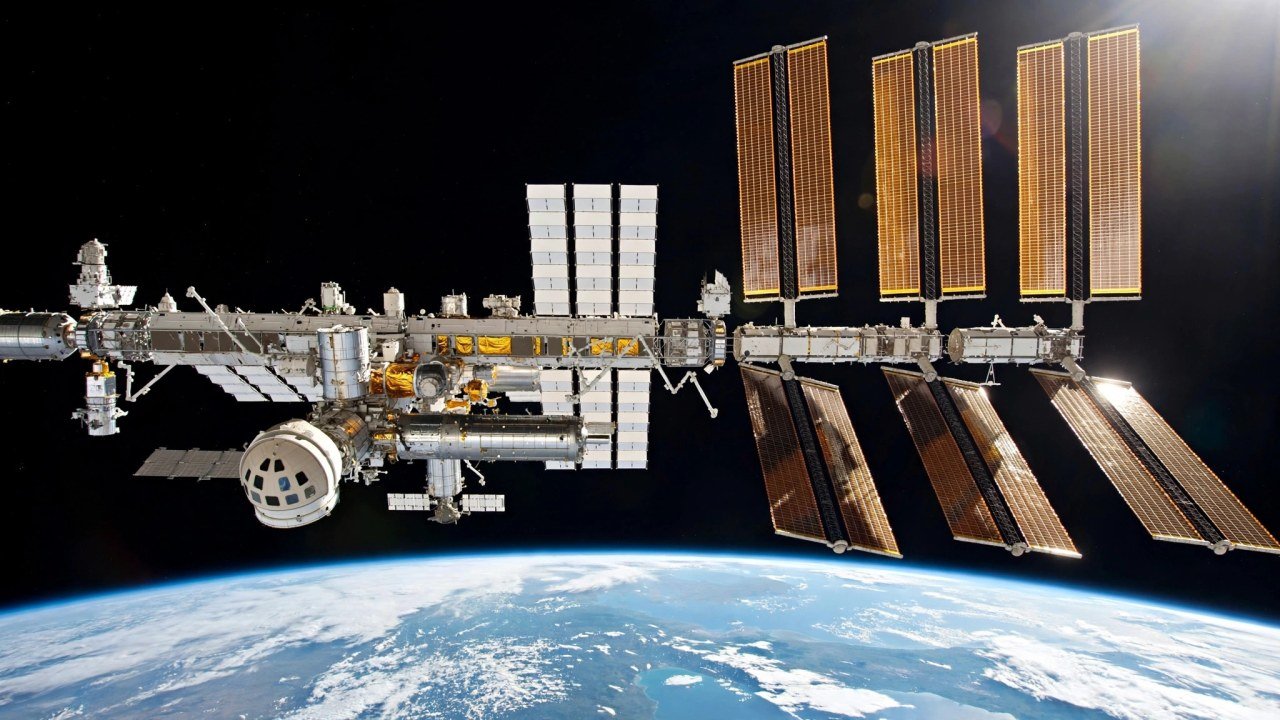
The spacewalk in numbers
The outing was U.S. spacewalk 101, and the 286th spacewalk carried out in support of station assembly, maintenance and upgrades. It was the ninth spacewalk of 2026 and the sixth by members of the station's Expedition 75 crew.
Menon and Kutryk switched their spacesuits to battery power at 8:36 a.m. EST and returned to the Quest airlock at 3:35 p.m. EST — 6 hours and 59 minutes outside. It was Menon's fifth spacewalk, taking his total time outside to 33 hours and 30 minutes, and Kutryk's second, taking his to 14 hours and 10 minutes.
The work itself was far from simple. The pair retrieved the 750-pound (340-kilogram) array assembly from a temporary stowage platform, moved it to the worksite with the Canadarm2 robotic arm, and mounted it on the 3B power channel at the far starboard end of the station's main truss. After a power check that needed troubleshooting, they released two bolts and watched the array unroll on its own to its full length of 63 feet (19 metres).
There is no motor in that unfurling. The array is held rolled up under tension, and stored elastic energy in its carbon-fibre composite booms drives it open — the same trick used by the seven arrays before it.
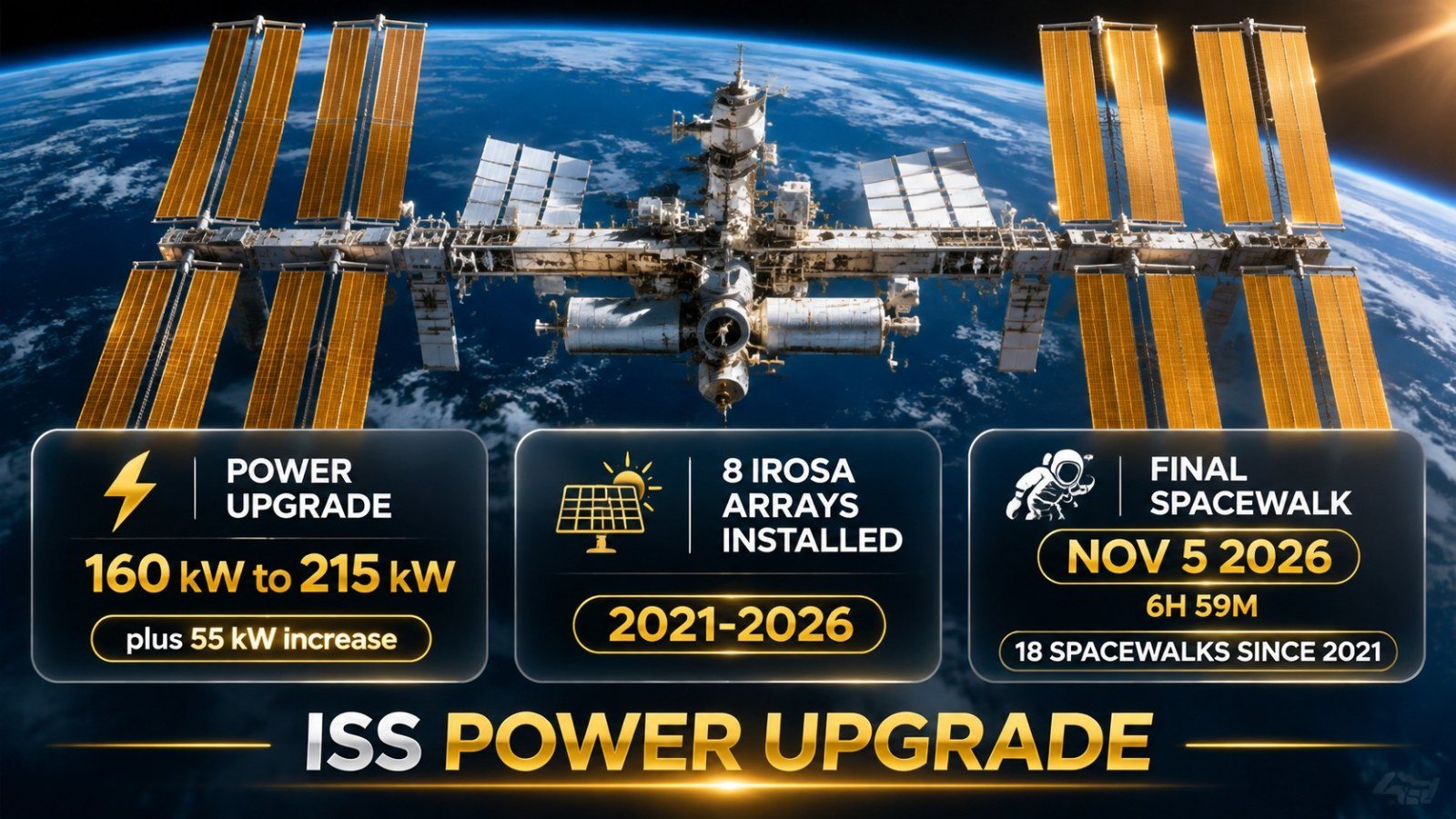
ISS power upgrade at a glance: 160 kW to 215 kW, eight IROSA arrays, final spacewalk November 5, 2026.
What is an IROSA?
IROSA stands for International Space Station Roll-Out Solar Array. Unlike the station's original solar wings, which are rigid panels, an IROSA arrives rolled up like a yoga mat and unrolls in space. Each one generates about 8 kilowatts — less than the 19 kilowatts each original wing produced when new, but the roll-out arrays are not replacements. They sit in front of the older wings and add power on top of them.
The first operational IROSA unrolled in June 2021. Six were in place by June 2023. NASA then ordered a final pair, and the seventh was installed by the same two astronauts on October 29, 2026, in a spacewalk lasting 7 hours and 11 minutes. The eighth, on November 5, finished the set.
In total, astronauts completed 18 spacewalks to prepare the power channels and install all eight arrays. The arrays themselves were all delivered to the station by SpaceX Dragon cargo spacecraft.
Why the station needed more power
The station's eight original solar wings were delivered by space shuttles between 2000 and 2009 and designed for about 15 years of service. They still work, but their output has degraded with age, just as flight controllers expected. The extra arrays were ordered because the station needs more electricity, not less, as it ages: more experiments, more commercial activity, and the systems that will keep it flying safely until its planned retirement.
That retirement is currently scheduled for late 2030, when NASA plans a safe and controlled deorbit. The upgraded power system is designed to support the station through those final years, including the deorbit itself.
What 215 kilowatts actually means
Kilowatts are a measure of capacity, not a promise that the station draws 215 kilowatts at every moment. The station passes through Earth's shadow on every 90-minute orbit, so batteries remain essential when the arrays are in darkness. What the upgrade changes is the ceiling: with more generating capacity, the station can run more experiments at once, support visiting vehicles, and keep its life-support and research systems comfortable rather than rationed.
It also matters for what comes next. The lessons from IROSA — compact, lightweight arrays that deploy without motors — are already shaping solar power designs for the Moon and Mars, where every kilogram counts and there is no crew outside to unfold a panel by hand.
What happens next
With the power upgrade finished, NASA's next planned U.S. spacewalks are targeted for early January, to upgrade the Alpha Magnetic Spectrometer, a cosmic-ray detector mounted on the station's truss. That was announced at an October 20 briefing by Gaurang Patel, operations integration manager for NASA's Low Earth Orbit Program.
Meanwhile, Expedition 75 continues its science programme. In the same week as the final array installation, the crew returned to botany and biomedical research, packed a SpaceX Dragon cargo spacecraft that arrived on October 15 for its return to Earth, and prepared plant and blood samples for analysis back on the ground.
Frequently asked questions
How much power does the ISS have now? About 215 kilowatts of generating capacity, up from about 160 kilowatts before the roll-out arrays were added.
How many IROSA arrays are there? Eight in total. The first was installed in June 2021 and the eighth and final one on November 5, 2026.
Who installed the final array? NASA astronaut Anil Menon and Canadian Space Agency astronaut Joshua Kutryk, during U.S. spacewalk 101.
How long did the final spacewalk last? 6 hours and 59 minutes, from 8:36 a.m. to 3:35 p.m. EST on November 5, 2026.
When will the ISS retire? NASA currently plans a controlled deorbit in late 2030. The upgraded power system is meant to support the station until then.
Sources
NASA Space Station blog, "Spacewalkers Install Final Roll-Out Solar Array" (November 5, 2026); NASA Space Station blog, "Botany, Biomedicine, and Cargo Ops Wrap Up Week Aboard Station" (November 13, 2026); Spaceflight Now, "Spacewalkers complete five-year effort to upgrade space station power supply" (November 5, 2026).
Related reading on ISS Tracker: How Does the International Space Station Get Electricity? — https://iss-tracker.net/news/how-does-the-international-space-station-get-electricity/ — How Big Is the International Space Station? — https://iss-tracker.net/news/how-big-is-the-international-space-station/ — Why Doesn't the ISS Fall to Earth? — https://iss-tracker.net/news/why-doesnt-the-iss-fall-to-earth/