
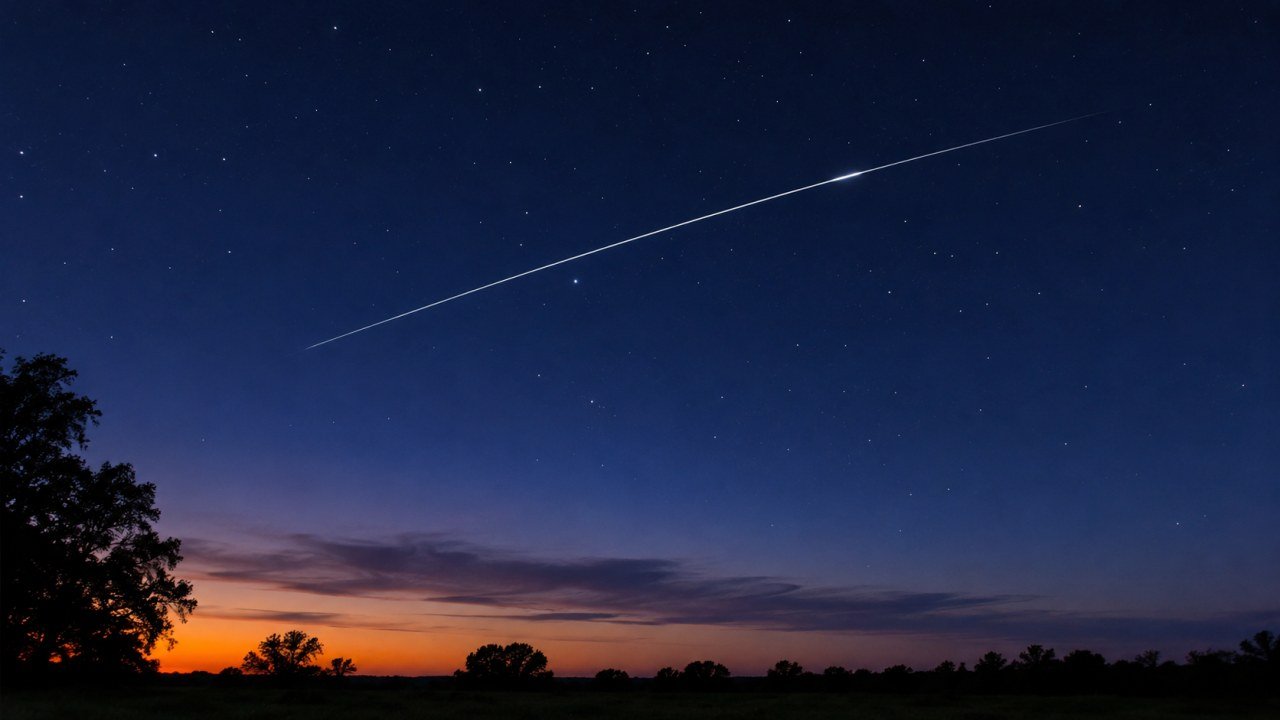
The trick is timing. The station isn't visible all night, every night. It shows up at certain hours, moves fast, and is gone again in a few minutes. But once you know why it shines and when to look, spotting it is surprisingly easy — most people who try see it on their first attempt.
Why it shines
The station makes no light of its own. What you see is sunlight bouncing off it, the same reason the Moon shines.
It works because the ISS is big — about the size of a football field — and covered in reflective surfaces, including its huge solar arrays. When sunlight catches those surfaces, the reflected light is strong enough to reach your eyes from 250 miles up.
But there is a catch. The station is not bright enough to stand out against a daylight sky. You need darkness on the ground while the station is still in sunlight high above you. That combination is exactly what dawn and dusk provide, which is why those are the hours to watch.
The station's orbit helps too. It is tilted at 51.6 degrees to the equator, and its path carries it over about 90 percent of the Earth's population. If you live under that path — and most people do — the station has almost certainly passed over your head already, probably without you noticing.
When to look
The best time is within a few hours after sunset, or a few hours before sunrise.
At those times your sky is dark enough for the station to stand out, while 250 miles above you the station is still bathed in full sunlight. In the middle of the night, the station usually slips into Earth's shadow and goes dark, even while it is still passing overhead.
A pass lasts about one to six minutes. That sounds short, but it is plenty of time to watch the station sweep across a large part of the sky — as long as you know when to step outside.
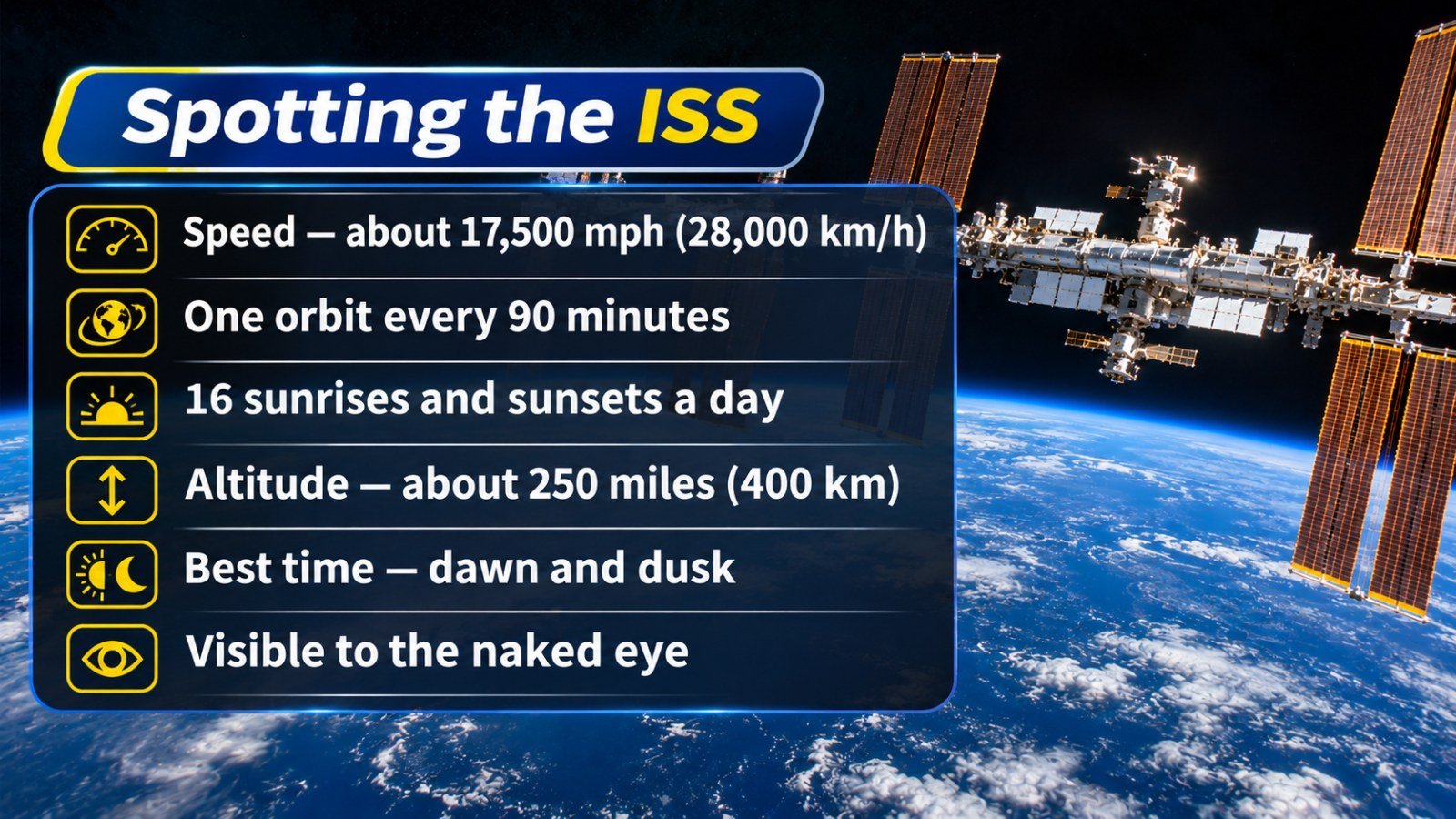
The crew on board live this cycle constantly. The station circles Earth once every 90 minutes, so the astronauts see 16 sunrises and 16 sunsets every single day.
How to find your next pass
Guessing won't work. The easy way is NASA's free Spot the Station app, available for iPhone and Android.
Set your location once and the app does the rest. It lists your upcoming visible passes with the time, the direction to look, how high the station will climb in degrees, and how long the pass will last. It can also send you a push notification — but only for passes you can genuinely see, not for every time the station crosses your sky.
Before a pass, check those three details: time, direction and maximum height. A pass that climbs 40 degrees or more above the horizon is a good one. Then find a spot with a clear view of the sky and be outside a few minutes early. The station runs on schedule, and a short pass is easy to miss if you are still getting ready when it appears.
What it looks like
The station moves from west to east, a smooth, silent white light gliding across the sky. It doesn't blink — and that is the easiest way to tell it apart from an aeroplane, which almost always has flashing lights.
On a good pass it may start faint near the horizon, grow brighter as it climbs, and then fade or vanish suddenly when it slips into Earth's shadow. That sudden disappearance surprises first-time watchers, but it is normal: the station has simply flown out of the sunlight.
You can watch all of this with your naked eye. Binoculars aren't needed, though they can show extra detail on a high pass — even the shape of the solar arrays, if your hands are steady.
Remember what you're looking at while you watch: a football-field-size laboratory travelling at about 17,500 miles per hour (28,000 kilometres per hour), 250 miles (400 kilometres) above your head, with seven people living and working inside it.
Tips for a great sighting
A little preparation turns a maybe into a definite.
Pick a pass with a good maximum height — 40 degrees or higher — and note the direction it will appear. Choose somewhere with a wide, open view of the sky; buildings and trees block the station most when it is low on the horizon, which is exactly where it appears and disappears.
Get outside a few minutes early and let your eyes adjust to the dark. Avoid bright lights and phone screens if you can, and give yourself a moment to scan the sky.
Then look for a steady white light moving west to east. Once you catch it, just follow it across the sky until it fades into Earth's shadow. It takes a few minutes, costs nothing, and it is the closest most of us will ever get to watching a crewed spacecraft fly overhead.
Frequently Asked Questions
Can you see the ISS with the naked eye?
Yes. The ISS is visible to the naked eye and no telescope is needed. Binoculars can show more detail, such as the solar arrays.
When is the best time to see the ISS?
Within a few hours after sunset or before sunrise, at dawn and dusk. It is not bright enough to see in daylight.
How long does an ISS pass last?
A pass usually lasts about 1 to 6 minutes.
How fast is the ISS travelling?
The ISS travels at about 17,500 mph (28,000 km/h). It orbits Earth once every 90 minutes at an altitude of about 250 miles (400 km).
How do I know when the ISS will pass over me?
Use NASA's free Spot the Station app for iOS and Android. It gives pass times, direction, maximum height in degrees and duration, and sends push notifications for visible passes only.
Sources
NASA — Spot the Station Frequently Asked Questions.
NASA — International Space Station (nasa.gov/station).
Related reading
How Do Astronauts Sleep on the International Space Station? — ISS Tracker
What Do Astronauts Eat on the International Space Station? — ISS Tracker
How Do Astronauts Exercise on the International Space Station? — ISS Tracker
The ISS at a glance