ISS Tracker › Space News › Cygnus XL Launches Sunday: The Final Cargo Delivery of 2026
Space News
Cygnus XL Launches Sunday: The Final Cargo Delivery of 2026
Northrop Grumman's Cygnus XL cargo ship launches Sunday 29 November on a SpaceX Falcon 9, carrying about 11,000 pounds of science and supplies to the Expedition 75 crew — the final cargo delivery of 2026.
By Stephen Carter · November 27, 2026
The last delivery of the year is about to leave Florida.
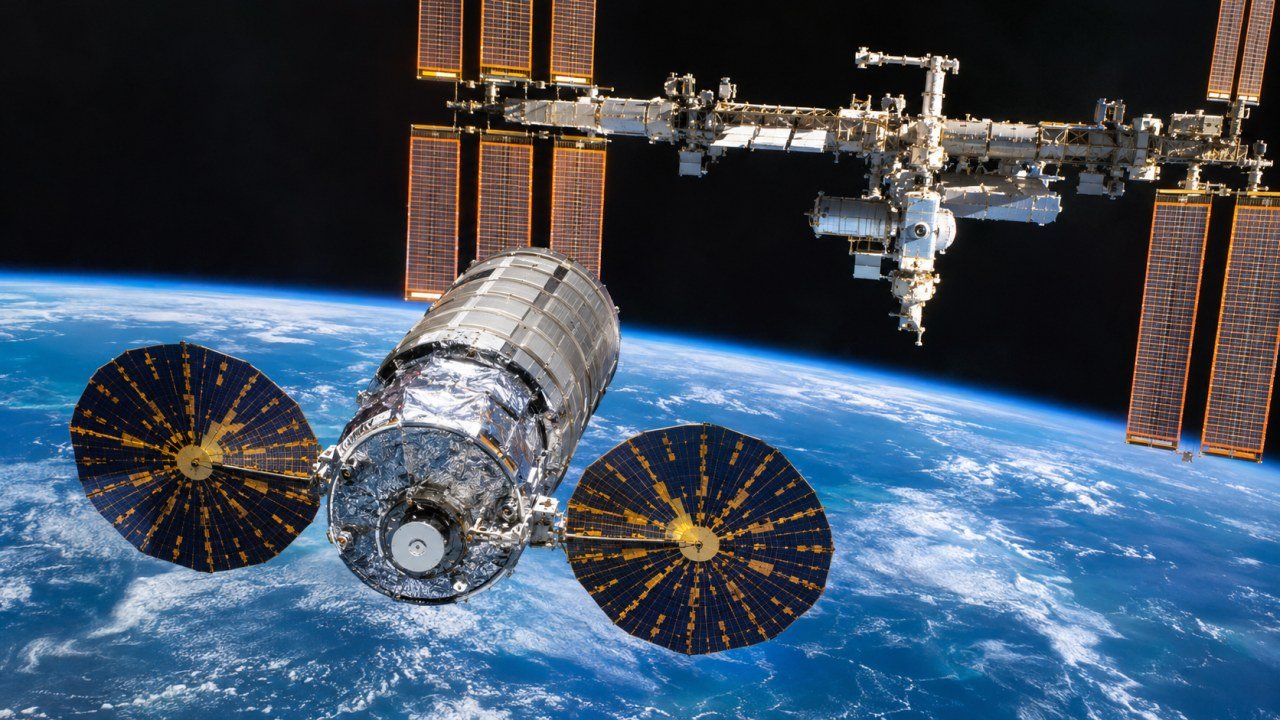
On Sunday morning, a cargo spacecraft with no one on board will ride a SpaceX Falcon 9 rocket into orbit, carrying around 11,000 pounds of science and supplies to the seven astronauts of Expedition 75. Its name is Cygnus XL, and it is the final cargo run to the International Space Station in 2026.
## A Sunday morning launch
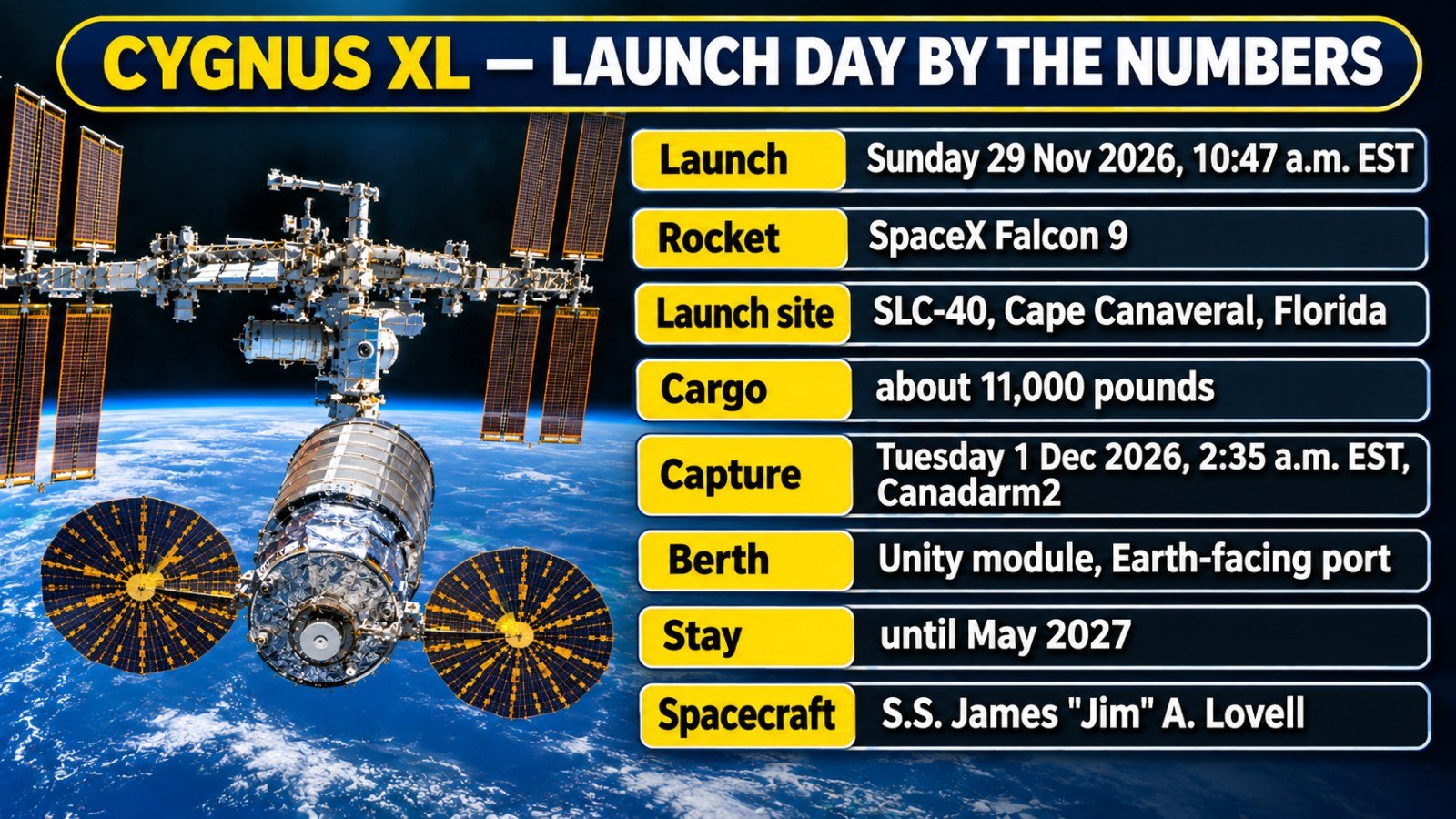
The launch is targeted for no earlier than 10:47 a.m. Eastern time on Sunday, 29 November — 8:47 p.m. in Pakistan. NASA's live coverage begins at 10:25 a.m. Eastern.
The rocket is a Falcon 9, lifting off from Space Launch Complex 40 at Cape Canaveral Space Force Station in Florida. Once it clears the tower, Cygnus XL will spend about two days chasing the station before the crew brings it in.
The spacecraft itself carries a name with history behind it. Northrop Grumman called it the S.S. James "Jim" A. Lovell, after the former NASA astronaut who commanded Apollo 13. Lovell never landed on the Moon — his mission was cut short by an explosion on the way there — but he brought his crew home safely against the odds. Naming a supply ship after him is, in its own quiet way, a reminder of what these flights are for: keeping people alive and working, a quarter of a million miles from home.
## What's inside
Cygnus XL is not carrying food alone, though there will be plenty of that. The heart of this load is science — experiments that can only be done properly in weightlessness, and that matter as much on Earth as they do in orbit.
NASA's list covers research into how cancer cells move, engineered muscle tissue, and DNA-inspired particles. There is also work on drug delivery, on muscle loss, on sensing radiation, and on growing food for future long-duration missions.
Those are big questions, and they connect directly to life down here. How a cancer cell travels through the body. How muscle wastes away when it is not used — something that happens to astronauts in weeks and to bed-bound patients on Earth over months. How to grow food where there is no soil and no shop. The station is the only laboratory where these things can be tested without gravity getting in the way, and every cargo flight keeps that laboratory running.
## Caught, not docked
Here is the part that makes Cygnus different from the Russian Progress ships. It does not dock itself.
When Cygnus XL arrives on Tuesday, 1 December, it will hold position near the station while NASA astronauts Jessica Watkins and Luke Delaney take control of the Canadarm2 robotic arm. At about 2:35 a.m. Eastern — 12:35 p.m. in Pakistan — they will reach out with the arm and grab the spacecraft as it drifts alongside.
Then ground controllers take over, steering the arm to guide Cygnus XL into place on the Earth-facing port of the station's Unity module, where it will be bolted on for unloading.
It is a slow, deliberate manoeuvre, and that is the point. A spacecraft weighing several tonnes, moving at 17,500 miles an hour, is caught by hand — or rather, by a robotic hand operated by people who have practised the move many times. Progress ships do the same job automatically. Cygnus does it with a human touch.
## A long stay, and a fiery end
Once berthed, Cygnus XL is scheduled to stay at the station until May 2027 — about six months. The crew will unload the science and supplies, run the experiments, and gradually fill the spacecraft with the things the station no longer needs.
That is the other half of its job, and the reason it never comes home. Unlike SpaceX's Dragon, Cygnus cannot return cargo to Earth. When its time is up, it will leave the station loaded with several thousand pounds of rubbish and unwanted equipment, and burn up harmlessly as it re-enters the atmosphere.
It arrives full and leaves full of trash. The Progress ships work the same way. It is not glamorous, but without that rhythm — a ship in, a ship out, every few months — the station would slowly fill up with waste and run out of supplies.
## Why this one matters
This is the last cargo mission of 2026, and it comes just three days after Progress 97 docked on Thanksgiving Day. Two different spacecraft, from two different countries, delivering to the same crew in the same week. That is the station working as it was designed to work.
Cygnus has been flying to the station since a demonstration mission in 2013, with the first operational flight in 2014. Each trip since has added to a record that is easy to take for granted: regular deliveries, on schedule, to a laboratory that never closes.
Sunday's launch is one more turn of that wheel. A rocket, a named spacecraft, 11,000 pounds of cargo, and a crew waiting 250 miles up to catch it.
## FAQ
**When will Cygnus XL launch?**
No earlier than 10:47 a.m. Eastern Standard Time on Sunday, 29 November 2026 — 8:47 p.m. Pakistan time. NASA's launch coverage begins at 10:25 a.m. Eastern.
**What rocket is carrying Cygnus XL?**
A SpaceX Falcon 9, launching from Space Launch Complex 40 at Cape Canaveral Space Force Station in Florida.
**How much cargo is on board?**
About 11,000 pounds of science investigations, supplies and equipment, according to NASA.
**When will it arrive at the station?**
NASA astronauts Jessica Watkins and Luke Delaney will capture it with the Canadarm2 robotic arm on Tuesday, 1 December 2026, at about 2:35 a.m. Eastern (12:35 p.m. Pakistan time). It will then be installed on the Earth-facing port of the Unity module.
**How long will Cygnus XL stay at the station?**
Until May 2027. It will then depart carrying several thousand pounds of disposal items and burn up during re-entry.
**Can Cygnus XL bring cargo back to Earth?**
No. Unlike SpaceX's Dragon, it cannot return cargo. Its final job is to carry the station's waste away and burn up harmlessly.
## Sources
- NASA, "NASA Sets Coverage for Northrop Grumman CRS-25 Launch, Prelaunch," NASA news release, November 2026
- NASA, "Crew Awaits Thanksgiving Day Delivery as Another Cargo Craft Nears Launch," NASA Space Station Blog, 24 November 2026
- NASA, "Crew Works Biomedical Research Day Before Thanksgiving Space Delivery," NASA Space Station Blog, 25 November 2026
## Related reading
- Progress 97 Docks With the ISS on Thanksgiving Day
- How Do Astronauts Drink Water on the ISS? Inside the Station's 98% Recycling System
- How Fast Does the ISS Travel? Speed, Orbit and 16 Sunrises a Day
- How Do Astronauts Sleep on the International Space Station?
Source note: This article is an independent summary of public space-agency information. Readers can verify the mission facts using the original source cited in the article.