
The International Space Station (ISS) is much bigger than it looks when you see it as a bright dot in the night sky. It is a huge space laboratory made from many connected sections and has been built over many years.
But exactly how big is the International Space Station?
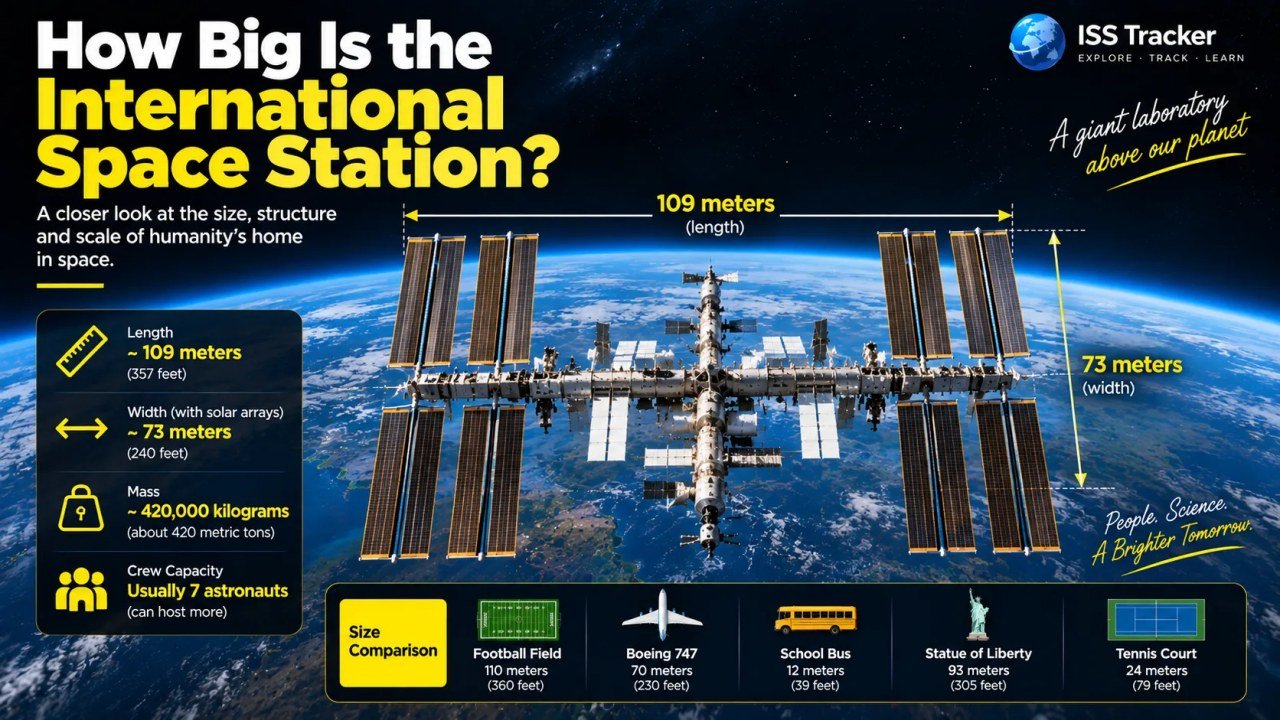
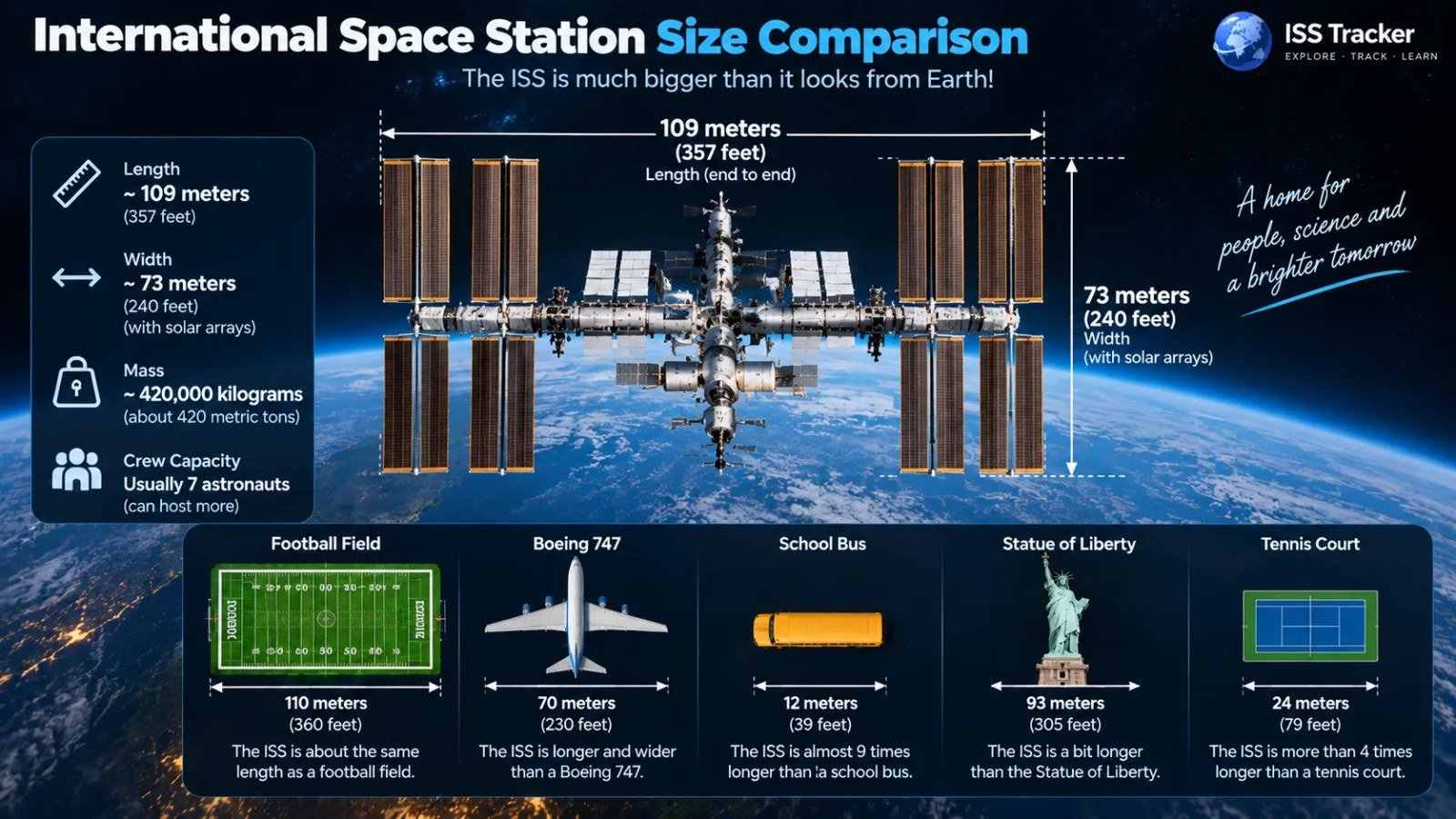
The ISS is about 109 meters (357 feet) long and about 73 meters (240 feet) wide when its large solar arrays are included. Its mass is roughly 420,000 kilograms, or about 420 metric tons.
How Long Is the ISS?
The International Space Station is about 109 meters long from end to end.
That is around the length of a football field, making the ISS much longer than most people imagine. However, it is not shaped like a long building. Its main sections are connected together, while large solar panels extend outward on both sides.
The station has grown over time as new modules and equipment have been added.
How Wide Is the ISS?
The ISS is about 73 meters wide when its solar arrays are included.
The large solar panels are one of the most noticeable parts of the station. They collect sunlight and turn it into electricity that helps power the laboratories, computers, life-support systems and other equipment used by astronauts.
Without these panels, the main structure of the ISS would look much narrower.
How Much Does the ISS Weigh?
The International Space Station has a mass of around 420,000 kilograms, which is about 420 metric tons.
That number can be hard to imagine. The station is so massive because it contains laboratories, living areas, scientific equipment, solar arrays, storage systems and many other parts needed to support people in space.
Its mass has also changed over the years as new equipment and spacecraft have visited the station.
How Big Is the ISS Compared With Earth?
Even though the ISS is enormous for a spacecraft, it is tiny compared with Earth.
The station travels around Earth in low Earth orbit while carrying astronauts and conducting scientific research. From the ground, its large size does not make it look like a giant object because it is hundreds of kilometers above the planet.
This is why the ISS can appear as a small, fast-moving point of light when you see it from Earth.
Why Does the ISS Need to Be So Big?
The ISS is not just a place where astronauts sleep. It is also a working laboratory in space.
Different parts of the station are used for science experiments, living, exercise, equipment storage and spacecraft operations. The large solar arrays provide the power needed to keep everything running.
Its size gives astronauts and researchers the space they need to live and work for long periods above Earth.
See the ISS in Real Time
The ISS may be huge, but it is always moving around our planet. If you want to see where it is right now, you can use our live ISS tracker to follow its current position.
Frequently Asked Questions
How long is the International Space Station?
The ISS is about 109 meters (357 feet) long.
How wide is the ISS?
It is about 73 meters (240 feet) wide when its solar arrays are included.
How much does the ISS weigh?
The ISS has a mass of roughly 420,000 kilograms, or about 420 metric tons.
Is the ISS bigger than a football field?
Its length is roughly comparable to the length of a football field, although the ISS has a very different shape.