ISS Tracker › Space News › How Do Astronauts Drink Water on the ISS? Inside the Station's 98% Recycling System
Guide
How Do Astronauts Drink Water on the ISS? Inside the Station's 98% Recycling System
Every drop of water on the ISS is used, cleaned and used again — including yesterday's sweat and urine. Here is how the station recycles about 98% of its water, and why astronauts say it tastes fine.
By Stephen Carter · November 25, 2026
Ask anyone what astronauts drink in space and you will get the same question back, usually with a nervous laugh: is it true they drink their own urine?
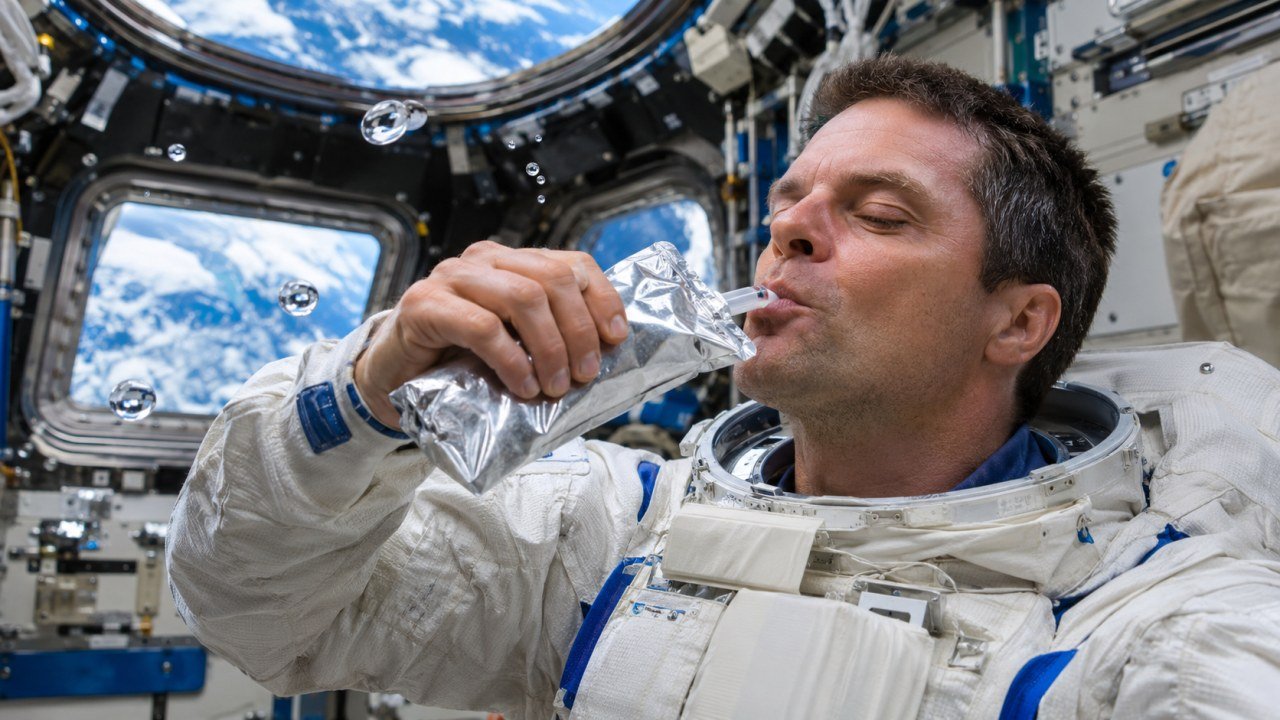
The short answer is yes — and also no. Yes, the water they drink today was, in part, urine yesterday. No, because by the time it reaches their lips it has been distilled, filtered, oxidised, tested and dosed with iodine, and NASA says it comes out cleaner than the water most of us drink at home. The crew is not drinking urine. They are drinking water that used to be urine, in the same way that the water in a river on Earth used to be something else.
It has to work this way. The station cannot be resupplied with drinking water every week — a litre of water weighs a kilogram, and every kilogram sent to orbit costs a fortune. So the station runs on a loop: collect every drop, clean it, and use it again.
## Where the water comes from
The station's Water Recovery System gathers wastewater from three places. The first is the one everyone asks about: urine, collected in the Waste and Hygiene Compartment. The second is the moisture in the cabin air — the sweat and breath of seven people, pulled out of the air by dehumidifiers. The third is hygiene water: the water used for brushing teeth, washing hands and the occasional sponge bath. A fourth source, water produced by the Sabatier reactor, used to feed into the same loop.
None of it is wasted. That is the whole point. The system was built on the idea that on a space station, wastewater is not waste at all. It is the next drink.
## First stop: the urine processor
Urine goes first to the Urine Processor Assembly, or UPA. It is a vacuum distillation unit — it heats the urine in a low-pressure chamber so the water boils off at a lower temperature, leaving the salts and solids behind.
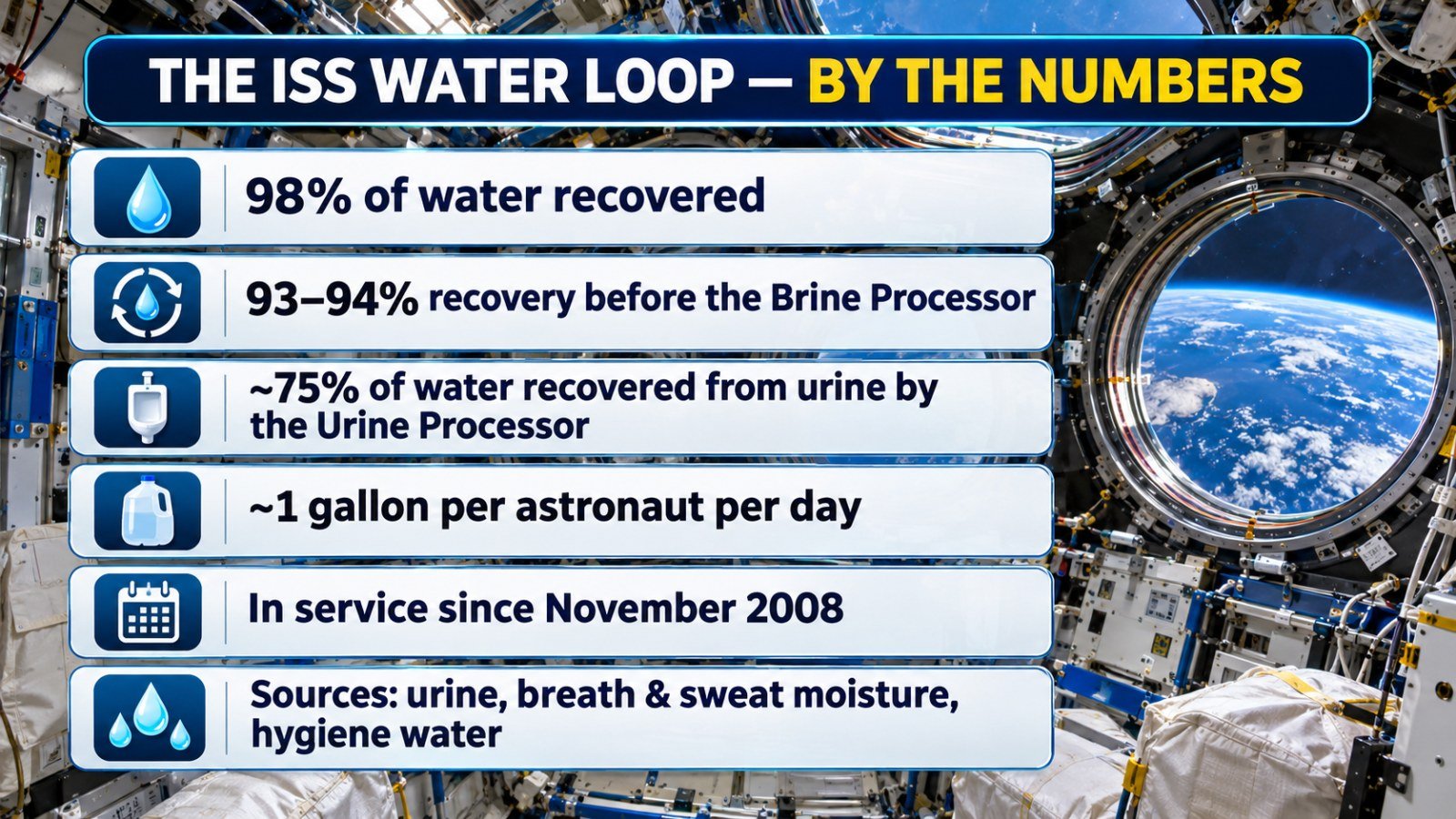
The UPA recovers about three quarters of the water from urine. That is a good start, but it leaves a problem: the leftover liquid, called brine, still holds a worthwhile amount of water. For years that brine was simply bagged up and thrown away with the rest of the station's waste, and total water recovery sat at about 93 to 94 percent.
Then NASA added the Brine Processor Assembly. It blows warm, dry air over the brine to evaporate the remaining water, then filters the vapour and collects it as clean water. That one addition pushed the whole system to about 98 percent recovery — the target NASA had set for long space journeys, where every drop counts.
Jill Williamson, NASA's water subsystems manager for the station, put it plainly: collect 100 pounds of water on the station, lose two pounds, and the other 98 percent just keeps going around and around.
## Then the water processor does the real cleaning
Whatever its source — urine distillate, brine water, or condensed sweat and breath — all of it flows into the Water Processor Assembly, the WPA. This is where the water is actually made drinkable.
It passes through a series of specialised filters that strip out particles, salts and organic contaminants. Then it goes through a catalytic reactor that breaks down any trace chemicals that are left. Sensors test the water constantly, and any batch that fails the purity checks is sent back through the system instead of to the crew. Only when it passes is iodine added — a small dose, to stop microbes growing in storage — and the water is pumped into tanks, ready to drink.
NASA is blunt about the result: the processed water meets strict purity standards, and by the time it is done, it is cleaner than most tap water on Earth.
## A gallon a day, each
How much does all this effort supply? Each crew member needs about a gallon of water a day — roughly four litres — for drinking, preparing food, and hygiene like brushing teeth. Some of that water also feeds the station's Oxygen Generation System, which splits water into oxygen for breathing and hydrogen, so the recycling loop quietly supports the air supply as well.
The hardware has been doing this job for a long time. The Water Recovery System was delivered to the station in November 2008 and lives in the Node 3 module, in two equipment racks. It has been repaired, upgraded and improved over the years — the brine processor was the biggest single jump — but the basic idea has not changed: nothing leaves the loop if it can be helped.
## Does it taste strange?
This is the question astronauts get asked most, after the urine one. The honest answer, from the crews who have lived with the system, is no. It tastes like water. There is no flavour of where it came from, because there is nothing left of where it came from. The filters and the reactor do not improve the water. They rebuild it.
It helps to remember that the water cycle on Earth works the same way, only slower and messier. Rain falls, rivers carry it, it passes through soil and treatment plants, and eventually it comes out of a tap. The station just does the same job in a pair of metal racks, in a few hours, with a lot more testing.
## Why it matters beyond the station
The 98 percent figure is not just a record. It is a rehearsal. A crew flying to the Moon or to Mars cannot count on a cargo ship turning up with fresh water every few weeks. On a Mars journey, the spacecraft will have to recycle almost everything it carries, for months or years at a time.
Every lesson the station learns — how to keep the filters working, how to squeeze the last water out of brine, how to keep the system running with almost no maintenance — goes straight into the life-support designs for those future missions. The astronauts drinking recycled water today are testing the plumbing that will keep the first Mars crew alive.
So yes, astronauts on the ISS drink recycled urine. They also drink recycled sweat, recycled breath and recycled toothpaste water. And the remarkable thing is not that they do it. It is that after nearly two decades of doing it, nobody can tell the difference.
## FAQ
**Do astronauts on the ISS drink recycled urine?**
Yes, in a sense. Urine is one of the sources of the station's recycled water, but it is distilled, filtered, oxidised and tested before it is drunk. NASA says the finished water is cleaner than most tap water on Earth.
**How much of the station's water is recycled?**
About 98 percent. The Water Recovery System hit that milestone after the Brine Processor Assembly was added; before that, recovery was about 93 to 94 percent.
**Where does the ISS get its water?**
From wastewater collected on board: crew urine, moisture condensed from cabin air (breath and sweat), and hygiene water. The system also used to take in water produced by the Sabatier reactor.
**How much water does each astronaut use per day?**
About a gallon — roughly four litres — for drinking, food preparation and hygiene.
**When was the water recycling system installed?**
The Water Recovery System hardware was delivered to the station in November 2008 and is located in the Node 3 module.
**Does the recycled water taste different?**
Astronauts report that it tastes like ordinary water. The purification process removes everything that could carry a taste or smell.
## Sources
- NASA, "NASA Achieves Water Recovery Milestone on International Space Station" — 98% recovery, Brine Processor Assembly, about a gallon per crew member per day, Jill Williamson quotes
- NASA, Environmental Control and Life Support System (ECLSS) — Water Recovery System, Urine Processor Assembly, Water Processor Assembly, filtration and catalytic reactor, iodine, purity sensors
- NASA NTRS, "Status of ISS Water Management and Recovery" (2026) — WRS delivered 14 November 2008, Node 3, UPA/WPA/BPA description, >95% recovery from brine processing
- Florida International University, "Water recycling is paramount for space stations" — UPA recovers about 75% of water from urine by vacuum distillation; BPA pushed recovery to 98%
## Related reading
- What Do Astronauts Eat on the International Space Station?
- How Do Astronauts Exercise on the International Space Station?
- How Fast Does the ISS Travel? Speed, Orbit and 16 Sunrises a Day
- Can You See the ISS From Earth? How to Spot the Space Station?
Source note: This article is an independent summary of public space-agency information. Readers can verify the mission facts using the original source cited in the article.