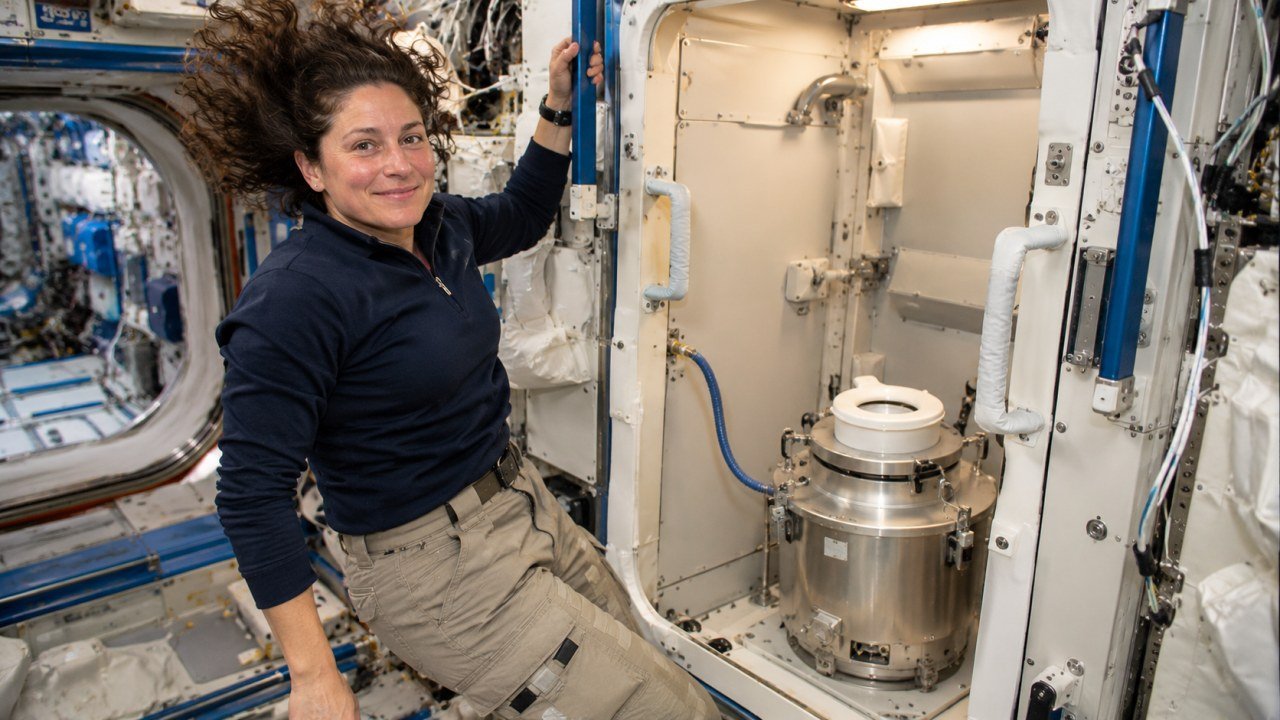
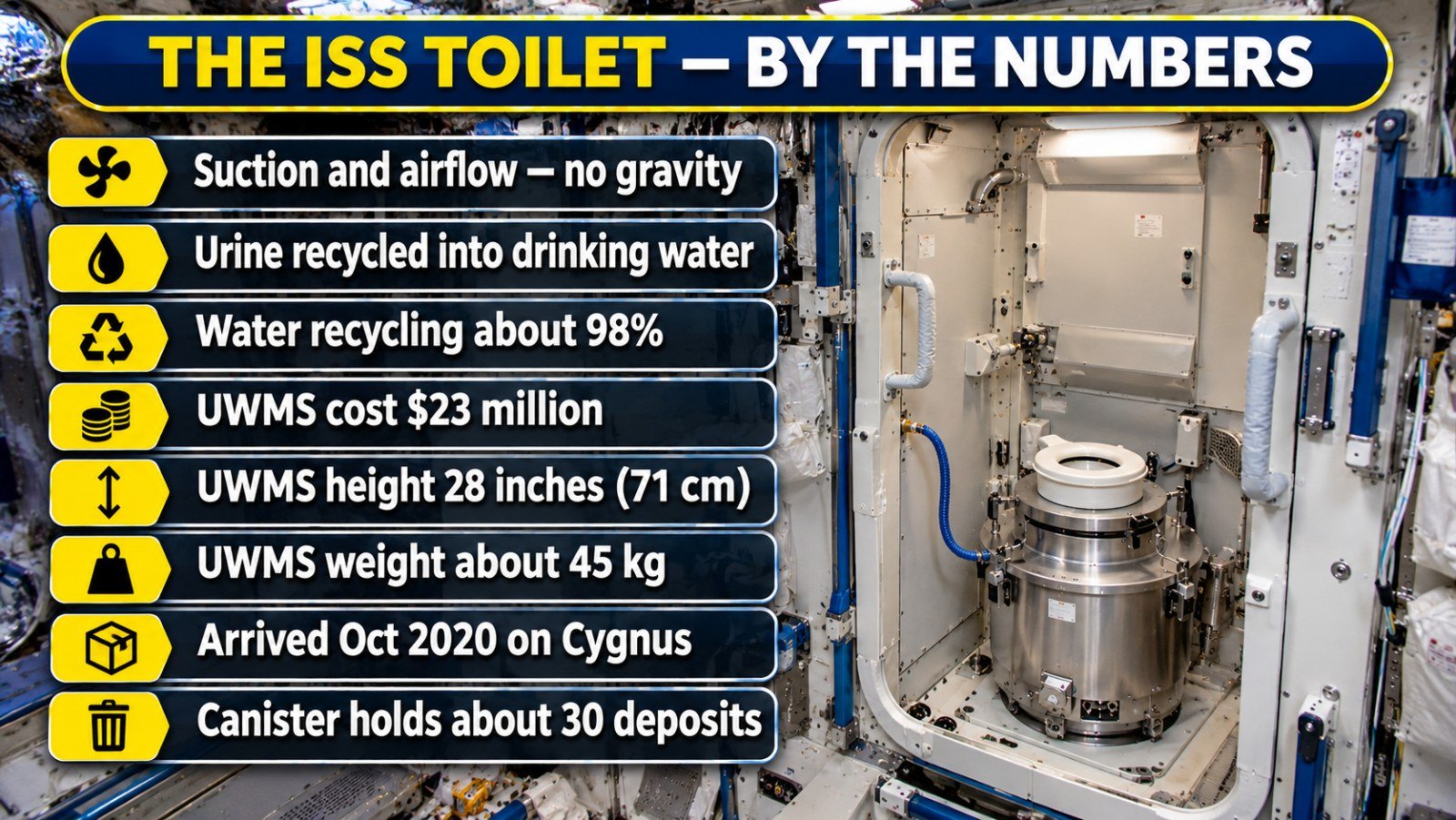
There is no gravity to pull waste down on the ISS, so the station's toilet uses suction and airflow — and the urine comes back as drinking water.
By Stephen Carter · November 28, 2026
It is the first question most people ask about life in space, and one of the most practical. On Earth, gravity does most of the work when you go to the bathroom. In orbit, there is no gravity to pull anything down. So how does it work on the International Space Station?
The answer is clever, a little strange, and surprisingly well thought out. The ISS toilet does not use gravity at all. It uses suction and airflow.
No gravity? Use air instead
Left to itself in microgravity, waste would simply float away — which, in a sealed cabin full of people and sensitive equipment, would be a serious problem. So ISS toilets use a fan to pull air through the funnel and the seat, dragging everything along with it.
Staying put is half the job. Astronauts strap themselves to the toilet with foot restraints and handholds, so they do not drift off at the wrong moment. New crew members get a full briefing and hands-on training before their first try. It is not something you want to get wrong.
Two parts, two methods
Using the toilet in space is a two-part job, and each part works a little differently.
To urinate, astronauts hold a suction funnel, attached to a hose, against their skin. The funnel uses airflow to pull the liquid away and into the system.
To pass solids, they sit over the seat. Suction starts automatically the moment the lid is lifted — which also helps keep smells down. The solid waste is sucked into a bag, which is sealed and pushed into a removable canister.
Each canister holds roughly 30 deposits. When one is full, it is packed away with the station's rubbish and loaded onto a cargo ship, which burns up harmlessly when it re-enters Earth's atmosphere.
Not glamorous. But tidy, contained, and designed for a place where nothing stays put on its own.
Today's coffee is tomorrow's coffee
Here is the part that surprises most people: urine is not thrown away. On the ISS, it is recycled into drinking water.
The urine goes to the station's water recycling system — first to the Urine Processor Assembly, then to the Water Processor Assembly — which turns it into clean drinking water. The station recycles about 98% of its water, including urine and sweat.
Astronaut Jessica Meir summed it up with a line that has stuck ever since: "today's coffee is tomorrow's coffee!"
Each crew member needs about 1 gallon — 3.8 litres — of water a day, for drinking, food preparation and washing. Carrying all of that up from Earth would be heavy, expensive and impractical for long missions. Recycling is not a clever trick. It is essential.
Meet the UWMS: the station's modern toilet
The current toilet on the American side of the station is called the Universal Waste Management System, or UWMS. It is a titanium unit, 28 inches (71 cm) tall, weighing about 45 kg. It is roughly 65% smaller and 40% lighter than the toilets it replaced — and on a spacecraft, every kilogram counts.
It cost $23 million to develop. That figure covers two units: one for the ISS, and one for the Orion capsule that will carry astronauts back to the Moon on Artemis II.
It took NASA about six years to build. The UWMS arrived at the station in October 2020 aboard a Northrop Grumman Cygnus cargo vehicle, and was installed in the Tranquility module, also known as Node 3.
One of its most important improvements is the funnel, redesigned with input from female astronauts so that women can urinate while seated. Earlier designs forced an awkward posture. It is a small change that makes a real difference for the whole crew.
The UWMS is the first new space toilet design in decades, and the same design is planned for Orion lunar missions. The station also still has older Russian-built toilets — in the Zvezda module, for example — so the crew has more than one option.
No shower, either
While we are on the subject: there is no shower on the ISS. Astronauts wash with wipes and rinseless shampoo instead. It is not the same as a long, hot shower. But it gets the job done, and it saves water — which, as we have seen, is precious in orbit.
A small room with a big job
Going to the bathroom in space sounds like a joke. It is actually a serious piece of engineering. Without a reliable toilet, astronauts could not stay in orbit for months at a time. Without water recycling, the station could not support its crew at all.
So the next time you hear about a mission to the Moon or Mars, spare a thought for the humble space toilet. Small, quiet, and mostly out of sight — and one of the reasons long space missions are possible in the first place.
FAQ
How do astronauts go to the bathroom in space?
They use a toilet that relies on suction and airflow instead of gravity. A fan pulls air through the funnel and seat, dragging waste along, and astronauts strap themselves in with foot restraints and handholds.
What happens to solid waste?
Solid waste is sucked into a bag, sealed, and pushed into a removable canister that holds roughly 30 deposits. Full canisters are disposed of with the station's trash on cargo ships that burn up on re-entry.
Is urine thrown away?
No. Urine goes to the station's water recycling system — the Urine Processor Assembly, then the Water Processor Assembly — and is turned into drinking water.
How much water does the station recycle?
The station recycles about 98% of its water, including urine and sweat.
What is the UWMS?
The Universal Waste Management System is the current ISS toilet. It is a titanium unit, 28 inches (71 cm) tall and about 45 kg. It cost $23 million to develop, took NASA about six years, arrived at the ISS in October 2020 aboard a Northrop Grumman Cygnus cargo vehicle, and was installed in the Tranquility module (Node 3).
Is there a shower on the ISS?
No. Astronauts wash with wipes and rinseless shampoo.
Sources
- NASA, via Space.com, "How do astronauts use the bathroom in space?" — suction and airflow, funnel, foot restraints and handholds, lid-lift auto-suction, canister ~30 deposits, urine to Water Recovery System, ~1 gallon (3.8 litres) per crew member per day, Jessica Meir quote
- Smithsonian Magazine, "NASA Just Sent a New $23 Million Space Toilet to the International Space Station," October 2020 — UWMS $23 million for two units, arrived 5 October 2020, ~65% smaller and ~40% lighter, funnel redesigned for female astronauts
- NASA, via phys.org, "Potty training: NASA tests new $23M titanium space toilet," October 2020 — 28 inches (71 cm), ~45 kg, titanium, installed in Tranquility, same design planned for Orion
Related reading
- How Do Astronauts Drink Water on the ISS? Inside the Station's 98% Recycling System
- What Do Astronauts Eat on the International Space Station?
- How Do Astronauts Exercise on the International Space Station?
- Why Astronauts Don't Get Enough Sleep in Space: The Science of the 6-Hour Night
Source note: This article is an independent summary of public space-agency information. Readers can verify the mission facts using the original source cited in the article.