
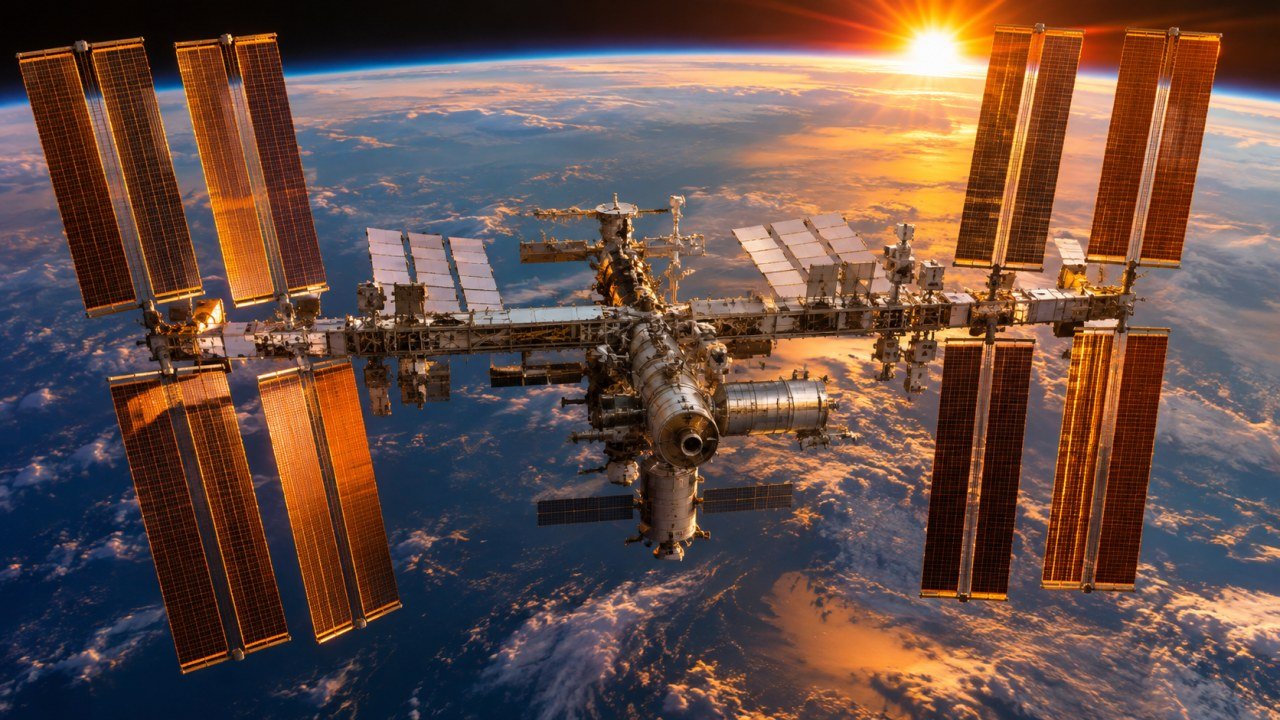
There is no "down" up there
The first thing to understand is that gravity is not holding anyone in place. An astronaut cannot lie down, because there is nothing to lie on and no direction that counts as down. Sleep in any orientation you like — on your side, upside down, floating upright. It makes no difference.
That freedom comes with a catch. An unsecured sleeper would drift around the cabin all night, bumping into equipment and other crew members. So every astronaut zips into a sleeping bag that is fixed to the wall. The bag keeps them still, and the snug fit feels a little like being swaddled. There is no mattress and no real need for one: with no weight pressing down, there are no pressure points on the back or neck. The bag does have a rigid cushion, though, so the back feels a gentle pressure — a small reminder of a mattress back on Earth.
A bedroom the size of a phone booth
Each astronaut gets a private sleep station, a cabin roughly the size of a telephone booth. Inside is the wall-fixed sleeping bag, a pillow, a lamp, an air vent, a laptop, and room for a few personal things — photos, a book, small reminders of home.
There are seven of these quarters on the station: two in the Russian Zvezda module, one in Nauka, and four in the American Harmony module. Seven small rooms for a crew that lives and works together around the clock. That little patch of privacy matters more than it sounds. On a station where you are never really alone, closing the door of your own sleep station is the closest thing to going home for the night.
Crew members who are only visiting — arriving on a spacecraft for a short stay — simply strap their sleeping bag to any free stretch of wall, or sleep inside their own vehicle.
Sixteen sunrises a day
Here is the part that makes sleep genuinely hard. The station races around Earth at about 17,500 miles per hour (about 28,000 km/h), completing one orbit roughly every 90 minutes. That means the crew watches the Sun rise and set sixteen times in a single day.
There is no natural day and night to set the body's clock, so the station runs on one instead: Coordinated Universal Time, or UTC. Wake-up, work, meals, exercise and sleep all happen at fixed times, the same every day, just as they would on Earth. The routine is the anchor. Sticking to it is what tells an astronaut's body that it is time to sleep, even as the Sun is rising for the fifth time that day outside the window.
It is the same discipline that keeps the rest of station life running. The station's electricity comes from its solar arrays, and its orbit never stops — but the crew's day is as regular as a shift on the ground.
The fan that keeps you alive
The most surprising thing about sleeping in space is not the floating. It is the air.
On Earth, the warm air you breathe out rises and drifts away. In weightlessness, nothing rises. The carbon dioxide you exhale can hang in place and gather into a bubble around your head while you sleep. Left alone, that bubble could leave you short of breath — or worse.
That is why every sleep station has a fan or vent aimed across the sleeper's face, running all night. It is not there for comfort. It is life support, quietly pushing fresh air in and sweeping exhaled air away. Crews aboard the old Russian station Mir learned this the hard way, waking up gasping in poorly ventilated quarters. On the ISS, the fans never stop.
Noise, light, and earplugs
The station never goes quiet. Fans, pumps, cooling systems and computers hum around the clock, and light leaks in from windows and equipment. So each astronaut is issued a sleep mask and a pair of earplugs, and both get used every night. The mask shuts out the light; the earplugs take the edge off the hum. It is not silence — nobody gets silence on the ISS — but it is enough.
Some astronauts say the steady background noise becomes soothing after a while, like sleeping next to a fan at home. Others never quite get used to it. Either way, the mask and earplugs are part of the bedtime routine, as fixed as brushing your teeth.
How much sleep do astronauts really get?
The schedule allows about 8.5 hours for sleep each day. In practice, astronauts average closer to 6 hours — many say that is all they need to feel fully rested. NASA's own guidance puts it simply: the crew typically gets eight hours of sleep after a 16-hour mission day, with the rest of the time given to work, meals, exercise and personal time.
Six hours may not sound like much, but in weightlessness the body is working less hard all day. No muscles straining against gravity, no weight on the joints. Rest comes easier, and it comes faster. What matters is not the number on the clock but whether the astronaut wakes up sharp — because on the station, a tired crew member is a safety risk, not just a grumpy one.
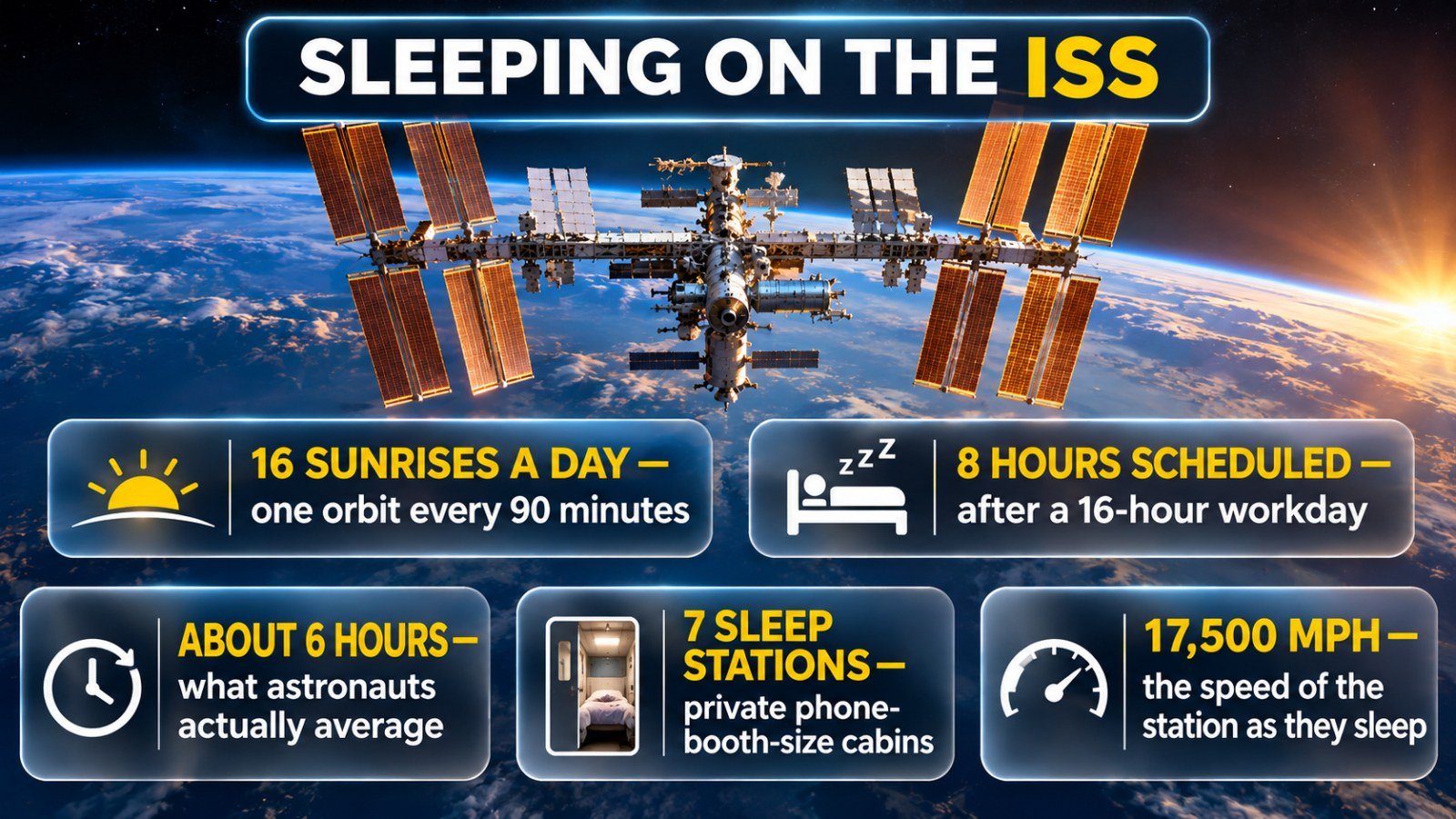
Sleeping on the ISS at a glance: 16 sunrises a day, 8 hours scheduled, about 6 hours actually slept, 7 sleep stations, 17,500 mph.
Frequently asked questions
Q: Do astronauts sleep lying down?
A: No. In microgravity there is no up or down, so astronauts can sleep in any orientation. They zip into a sleeping bag strapped to the wall so they do not float away during the night.
Q: Where do astronauts sleep on the ISS?
A: In small private rooms called sleep stations, about the size of a telephone booth. There are seven crew quarters: two in the Russian Zvezda module, one in Nauka, and four in the American Harmony module.
Q: Why do astronauts need a fan while they sleep?
A: In microgravity, exhaled carbon dioxide does not drift away and can form a bubble around a sleeping astronaut's head. Every sleep station has a fan or vent blowing air across the face to keep fresh air moving.
Q: How many sunrises do astronauts see each day?
A: The ISS orbits Earth about every 90 minutes, so the crew sees 16 sunrises and 16 sunsets every day. The station runs on Coordinated Universal Time (UTC) to keep a regular schedule.
Q: How much sleep do astronauts get?
A: Astronauts are allotted about 8.5 hours of sleep a day, but many report needing only about 6 hours to feel fully rested. The crew typically gets eight hours of sleep after a 16-hour mission day.
Sources
- NASA, "Living and Working in Space" fact sheet — crew typically gets eight hours of sleep after a 16-hour mission day; sleep mask and earplugs issued; sleeping bags attached to the wall.
- Canadian Space Agency, "Sleeping in space" — sleep stations the size of a telephone booth; about 8.5 hours allotted, many astronauts report about 6 hours; carbon dioxide bubble and air vent.
- NASA Space Station blog — Expedition 75 operations, November 2026.
Related reading
- How Does the International Space Station Get Electricity?
- Why Doesn't the ISS Fall to Earth? The Science Behind Its Orbit
- How Big Is the International Space Station?