
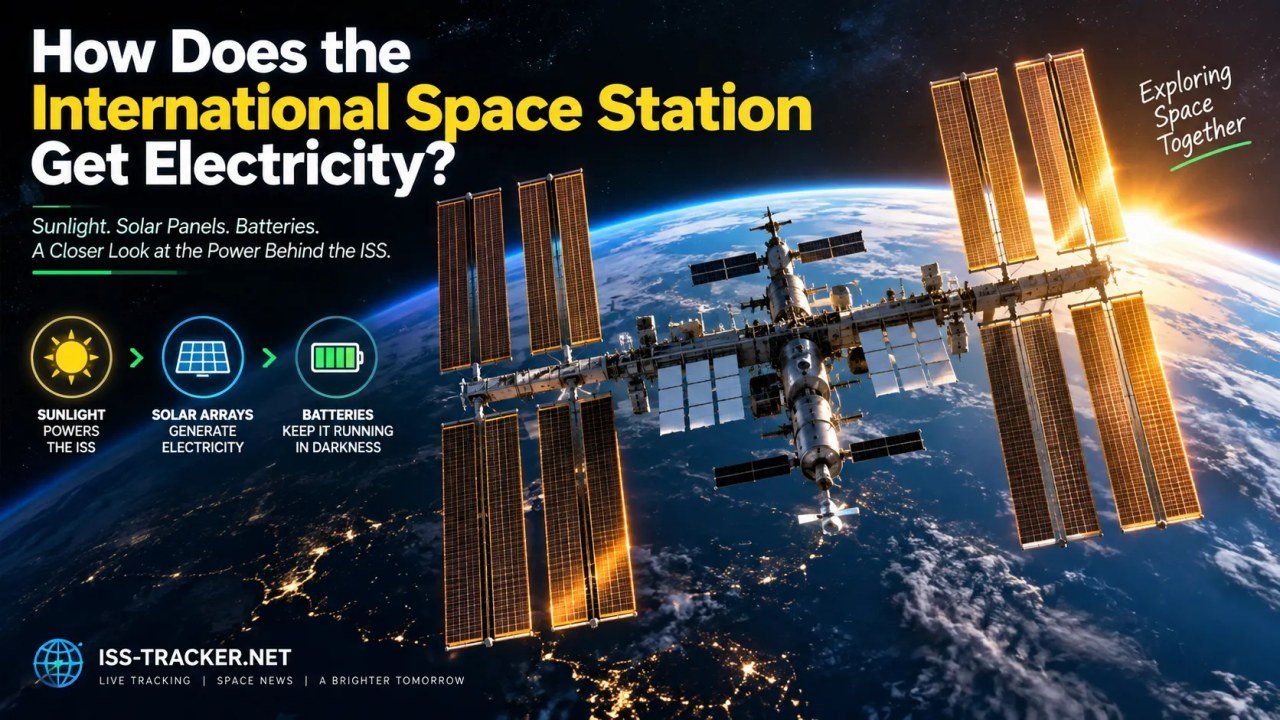
The International Space Station is a large laboratory that travels around Earth every day. Astronauts live and work inside it, scientists run experiments, computers operate constantly, and many machines need electricity.
But the ISS is hundreds of kilometers above Earth.
There are no power cables connected to it.
So how does the space station get the electricity it needs?
The answer is simple: the Sun provides most of its power.
The ISS Uses Solar Energy
The International Space Station has huge solar panels attached to its main structure.
When sunlight reaches these panels, special solar cells turn the sunlight into electrical energy. This electricity is then sent through the station's power system to run equipment and other systems.
The solar arrays are much larger than the solar panels people normally see on houses.
NASA says the station has eight main solar arrays, and its solar power system can produce a large amount of electricity for station operations and research.
The large size is important because the ISS has many systems that need power at the same time.
What Uses Electricity on the ISS?
Almost everything that operates on the station needs electrical power.
Astronauts use computers, lights, cameras and communication equipment. Scientific experiments also require electricity.
The station has systems that help control the temperature inside the modules. Other systems help manage air, water and other resources needed by the crew.
There are also pumps, control equipment and many other machines working in the background.
In other words, the ISS needs electricity not just for one or two devices, but for an entire working space laboratory.
What Happens When the ISS Goes Behind Earth?
There is an interesting problem with using solar power in space.
The ISS moves around Earth very quickly. During every orbit, the station eventually passes through Earth's shadow.
When the station is in sunlight, its solar arrays can collect energy.
When it enters Earth's shadow, those solar panels cannot receive direct sunlight.
So the station needs another way to keep its systems running.
This is where batteries become important.
The ISS Has Batteries
The electricity produced by the solar arrays does not all have to be used immediately.
Some of the available power can be stored in batteries.
When the ISS moves into Earth's shadow, the batteries provide electricity to the station.
Then, when the station reaches sunlight again, the solar arrays start producing electricity and the batteries can be charged again.
This cycle happens again and again as the ISS travels around Earth.
You can think of it like charging a large rechargeable battery during the day and using that stored energy when sunlight is temporarily unavailable.
Why Are the Solar Panels So Large?
The ISS needs a lot of energy, and sunlight is the main source available to it.
Making the solar arrays larger gives the station more surface area to collect sunlight.
The station's solar arrays stretch a long distance from the main body of the ISS. NASA lists the solar-array span at about 73 meters across the aligned arrays.
When you see a photograph of the ISS, the large rectangular solar panels are usually one of the easiest parts to recognize.
They also make the station look much bigger than it would appear from the central modules alone.
The ISS Has Newer Solar Arrays Too
The original solar arrays have been working for many years.
Like other equipment in space, solar arrays slowly become less effective as they age.
To help maintain the station's power supply, newer roll-out solar arrays have been added.
These arrays are designed to be compact for launch and then deployed after reaching the station.
The newer arrays work together with the existing solar power system rather than simply replacing the entire system. NASA says the roll-out arrays provide additional power for the station.
This is important because the ISS continues to support scientific research and other operations after many years in orbit.
How Does the ISS Point Its Solar Panels Toward the Sun?
The station is constantly moving around Earth, so its position relative to the Sun changes during the orbit.
The solar power system includes equipment that helps control the position of the arrays so they can collect sunlight efficiently.
This is not as simple as putting solar panels on a roof.
On Earth, a solar panel can stay in one place while the Sun appears to move across the sky.
On the ISS, the entire station is moving around Earth while Earth is also moving around the Sun.
The power system therefore has to work continuously as the station travels through different parts of its orbit.
What If a Solar Panel Is in Earth's Shadow?
Not every part of the station's solar power system is necessarily receiving sunlight at exactly the same moment.
Parts of the arrays can be affected by the position of the station and Earth.
When sunlight is unavailable, stored energy from the batteries helps supply the station.
The electrical system is designed to manage the available power and distribute it where it is needed.
This allows the ISS to continue operating even while it is temporarily traveling through darkness.
How Much Electricity Does the ISS Produce?
The amount of power available can change depending on the station's configuration and the condition of its solar arrays.
NASA's published ISS facts list the eight main solar arrays as providing roughly 75 to 90 kilowatts of power. Newer roll-out arrays have also been added to increase the station's power capability.
That is a huge amount of power for a spacecraft.
It allows the station to support life-support equipment, computers, scientific experiments, communications and many other systems.
Why Is Solar Power Important for the ISS?
Carrying a huge amount of fuel just to generate electricity would not be practical for a long-running space station.
The Sun provides an ongoing source of energy.
As long as the solar arrays can receive sunlight, they can produce electricity.
The batteries then help bridge the periods when the station is traveling through Earth's shadow.
This combination makes solar power a practical solution for a laboratory that has been operating in orbit for many years.
Can You See the ISS Solar Panels From Earth?
Sometimes, yes.
The International Space Station can become bright enough to see from Earth under the right conditions.
You normally need the right combination of location, time, weather and lighting conditions.
The large solar arrays help make the ISS highly reflective, which is one reason the station can appear as a bright moving point in the sky.
It does not look like a detailed spacecraft from the ground. Instead, it usually appears as a bright object moving steadily across the sky.
Track the ISS Live
The ISS is moving around Earth all the time, and its position changes from minute to minute.
If you want to see where the station is right now, you can use ISS Tracker to view its current position on an interactive map.
Track the International Space Station live:
https://iss-tracker.net/
You can also use the pass prediction tool to find out when the ISS may pass over your location.
Final Thoughts
The International Space Station gets most of its electrical power from sunlight.
Large solar arrays collect energy from the Sun and turn it into electricity. Batteries store energy so the station can continue operating when it moves through Earth's shadow.
The power system has also been upgraded over the years with newer roll-out solar arrays.
It may look simple when you see sunlight hitting a solar panel, but keeping a large laboratory powered in orbit is a complicated engineering job.
Every light, computer, experiment and important station system depends on a reliable supply of electricity.
And every time the ISS moves from darkness back into sunlight, its solar arrays begin collecting energy again for another trip around Earth.