
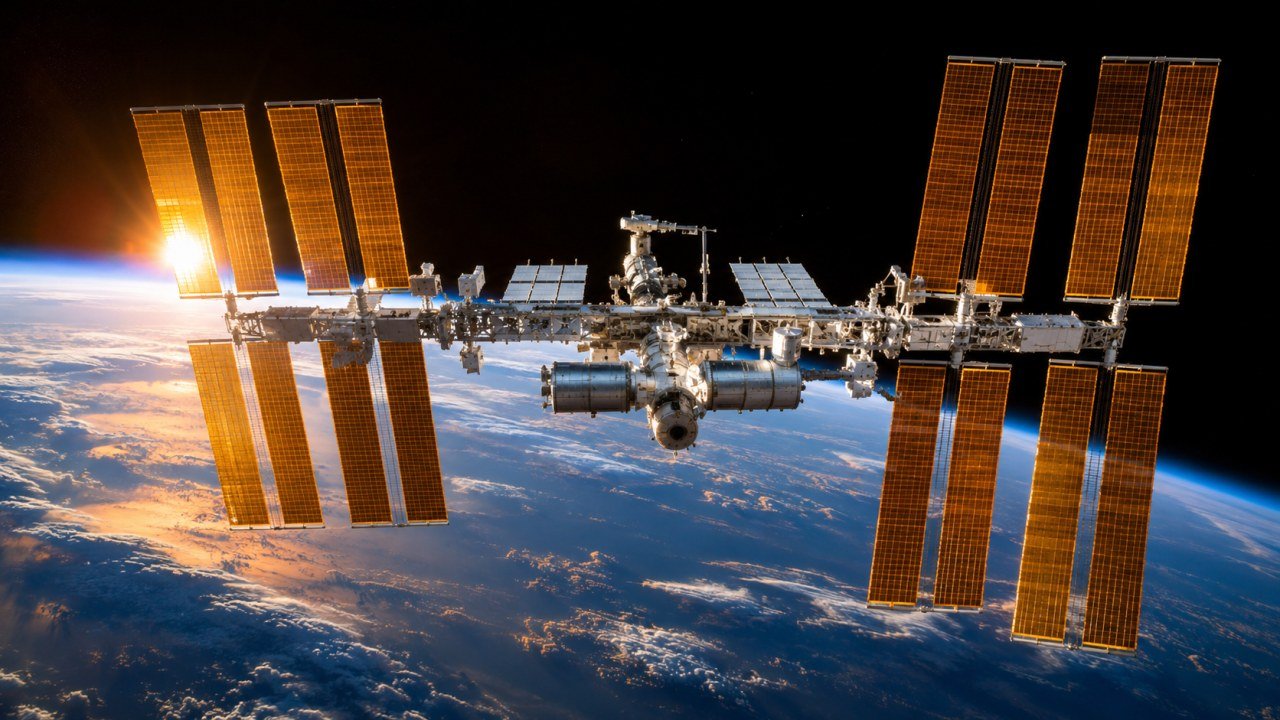
The International Space Station is the fastest thing most of us will ever see with our own eyes. It crosses the sky in a few minutes, silent and bright, and by the time you have pointed it out to someone standing next to you, it is already gone. The numbers behind that streak of light explain almost everything about how the station works.
The headline number: 17,500 miles per hour
The ISS travels at about 17,500 miles per hour — roughly 28,000 kilometres per hour, or close to 5 miles every second. That is around 30 times the cruising speed of a passenger jet. A plane flying at that pace would circle the equator in under two hours. The station does it in about 90 minutes.
Why it has to go that fast
The station orbits about 250 miles (400 kilometres) above Earth. That sounds high, but gravity up there is still about 88 percent as strong as it is on the ground. Nothing at that height simply floats. The only reason the ISS does not fall is that it is moving sideways so fast that, as it falls toward Earth, the ground curves away beneath it at exactly the same rate. Physicists call this falling around the Earth, and it is the same trick that keeps every satellite in orbit.
Slow the station down and the balance breaks: it would sink lower, meet thicker air, slow down further, and eventually fall out of orbit altogether. Speed it up and it would climb into a higher orbit. So 17,500 miles per hour is not a record the station is trying to set. It is the price of staying where it is. (We covered the falling question in more depth in our earlier article, Why Doesn't the ISS Fall to Earth?)
One lap every 90 minutes
At that speed, a full orbit takes about 90 minutes. Over a day the station circles the planet roughly 16 times, covering some 420,000 kilometres — further than the distance to the Moon and back, every single day. The orbit is tilted at 51.6 degrees to the equator, which is why the station passes over most of the places people actually live.
Sixteen sunrises and sunsets a day
Here is the part the crew talks about most. Because an orbit takes only 90 minutes, the astronauts aboard see a sunrise roughly every hour and a half — about 16 sunrises and 16 sunsets in a single day. The Sun drops below the horizon, the station plunges into darkness, and 45 minutes later it is morning again.
That rhythm shapes daily life on board more than most people realise. The crew works to a 24-hour schedule set by clocks, not by daylight, and the station's windows have shutters to block the Sun when it is time to sleep. The lighting system that returned to Earth aboard the Dragon cargo capsule on 21 November had spent more than three years testing how light affects astronaut sleep for exactly this reason.
How high is it, and why the height keeps changing?
The station's altitude is usually quoted as about 250 miles, but it is not fixed. Even at 400 kilometres up, there is still a whisper of atmosphere, and that thin air drags on the station constantly, pulling it a little lower every day. So the station gets regular boosts: a docked spacecraft fires its engines and pushes the whole 419-tonne structure back up, in a manoeuvre called a reboost. The speed shifts slightly with the height, because a lower orbit demands a slightly faster pace.
What does that speed feel like?
Nothing at all. That surprises people, but the crew feels no wind, no vibration, no sense of rushing through space. There is no air to rush past, and everything inside the station is moving at exactly the same speed. What they feel instead is weightlessness, the result of being in continuous free fall.
The speed only becomes visible from the ground. When the station passes overhead on a clear evening, it looks like a bright, steady star gliding across the sky, crossing from one horizon to the other in a few minutes. Our guide Can You See the ISS From Earth? explains how to find the next pass over your town.
FAQ
How fast does the ISS travel?
About 17,500 miles per hour (28,000 kilometres per hour), or roughly 5 miles per second. NASA uses this as its standard figure; the exact speed varies slightly with altitude.
How long does it take the ISS to orbit Earth?
About 90 minutes per orbit, which works out to roughly 16 orbits — and 16 sunrises — every day.
How high is the ISS?
About 250 miles (400 kilometres) above Earth, in low Earth orbit. The height drifts down slowly because of atmospheric drag and is raised again by engine burns from docked spacecraft.
Can you feel how fast the ISS is going?
No. The crew feels weightless, not fast, because everything aboard moves together at the same speed in the vacuum of space. The speed is only obvious when you watch the station cross the sky from the ground.
Why doesn't the ISS slow down?
It does, very gradually, because of drag from the thin air at its altitude. Regular reboosts from docked spacecraft push it back up and keep it in orbit.
Sources
- NASA, International Space Station facts and figures — speed, altitude, orbit period and station mass
- NASA, Spot the Station — sighting times and how the station moves across the sky
- NASA Space Station blog, 21 November 2026 — Dragon Returns to Earth Packed With Science and Cargo
Related reading
- Why Doesn't the ISS Fall to Earth?
- How Big Is the ISS?
- Can You See the ISS From Earth? How to Spot the Space Station
- How Do Astronauts Exercise on the International Space Station?
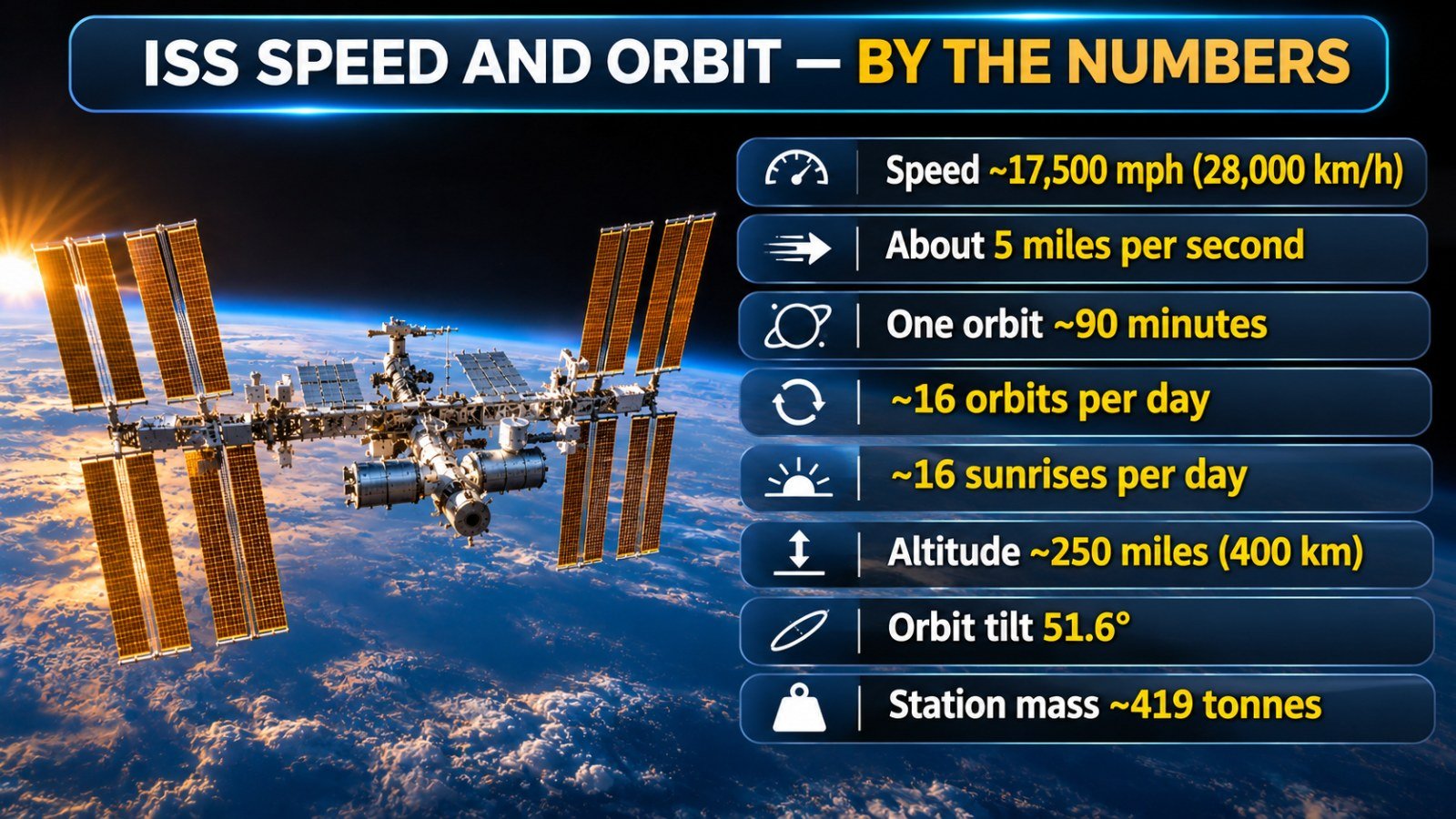
ISS speed and orbit at a glance: about 17,500 mph, one orbit every 90 minutes, 16 sunrises a day.