
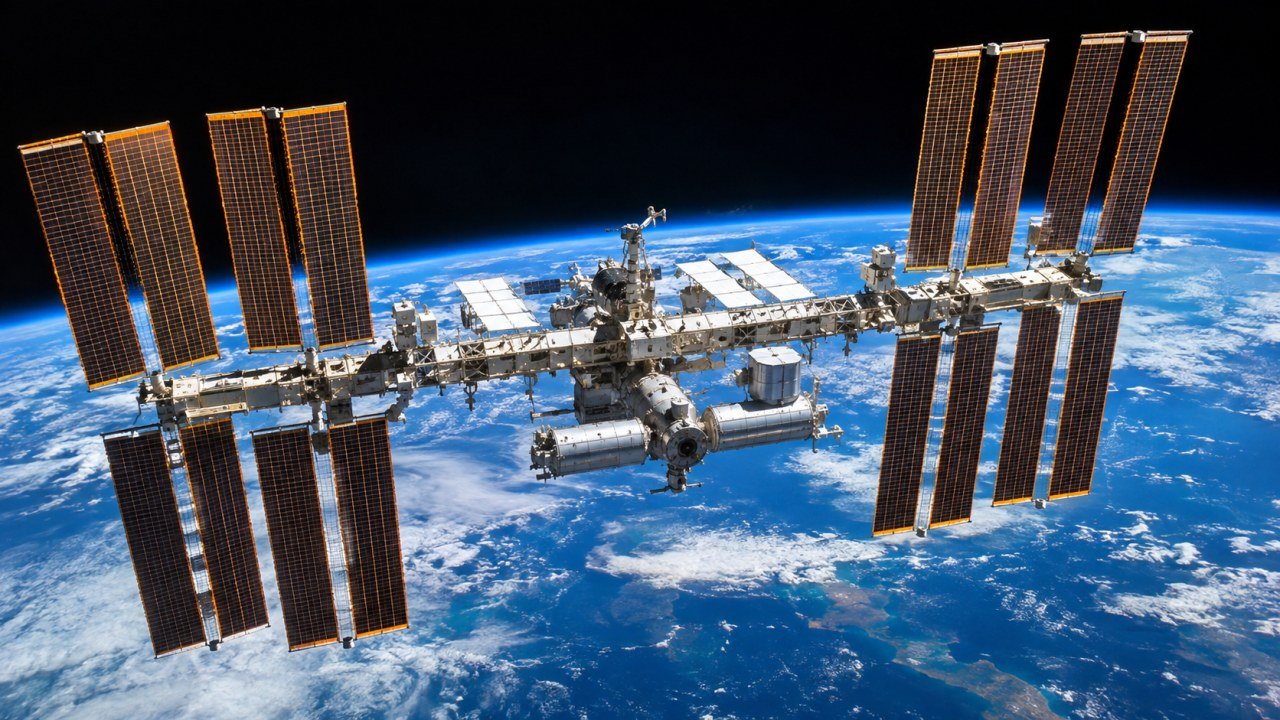
It was the same crew that had finished the station's five-year power upgrade just eight days earlier. This time the work was quieter, but no less part of the station's daily purpose.
Plants in orbit
The plant work fell to NASA flight engineer Luke Delaney. Inside the Japanese Kibo laboratory module, he harvested thale cress plants that had been growing on the Multi-use Variable-g Platform — a facility that lets researchers compare how living things respond to different levels of gravity.
Harvesting was only half the job. Delaney then treated the samples inside Kibo's Life Science Glovebox so they would survive the journey back to Earth in good condition for study. Once scientists on the ground can examine them, the results may help crews grow healthier plants on long missions, where fresh food matters more with every month away from Earth. The same findings could also feed back into farming on the ground — crops that stand up better to disease.
Medicine and the human body
Across the station, the biomedical work continued in parallel. NASA flight engineer Anil Menon swapped out sample cassettes and hard drives inside the Advanced Space Experiment Processor-4, or ADSEP-4, a piece of hardware that had recently supported pharmaceutical and microbiology research. Fresh samples and storage mean that line of work can carry on without a break.
Jessica Watkins, also a NASA flight engineer, switched on student-designed hardware built to watch how important physical, chemical and biological processes behave when gravity is taken out of the equation. The idea is simple enough: some things can only be understood properly in weightlessness. The payoff could be better technology on Earth and in space — and healthier astronauts on the missions to come.
Canadian Space Agency flight engineer Joshua Kutryk took part in a medical study of his own. With Watkins helping, he gave a blood sample, spun it in a centrifuge, and stowed it in a science freezer for later analysis on the ground.
The week at a glance
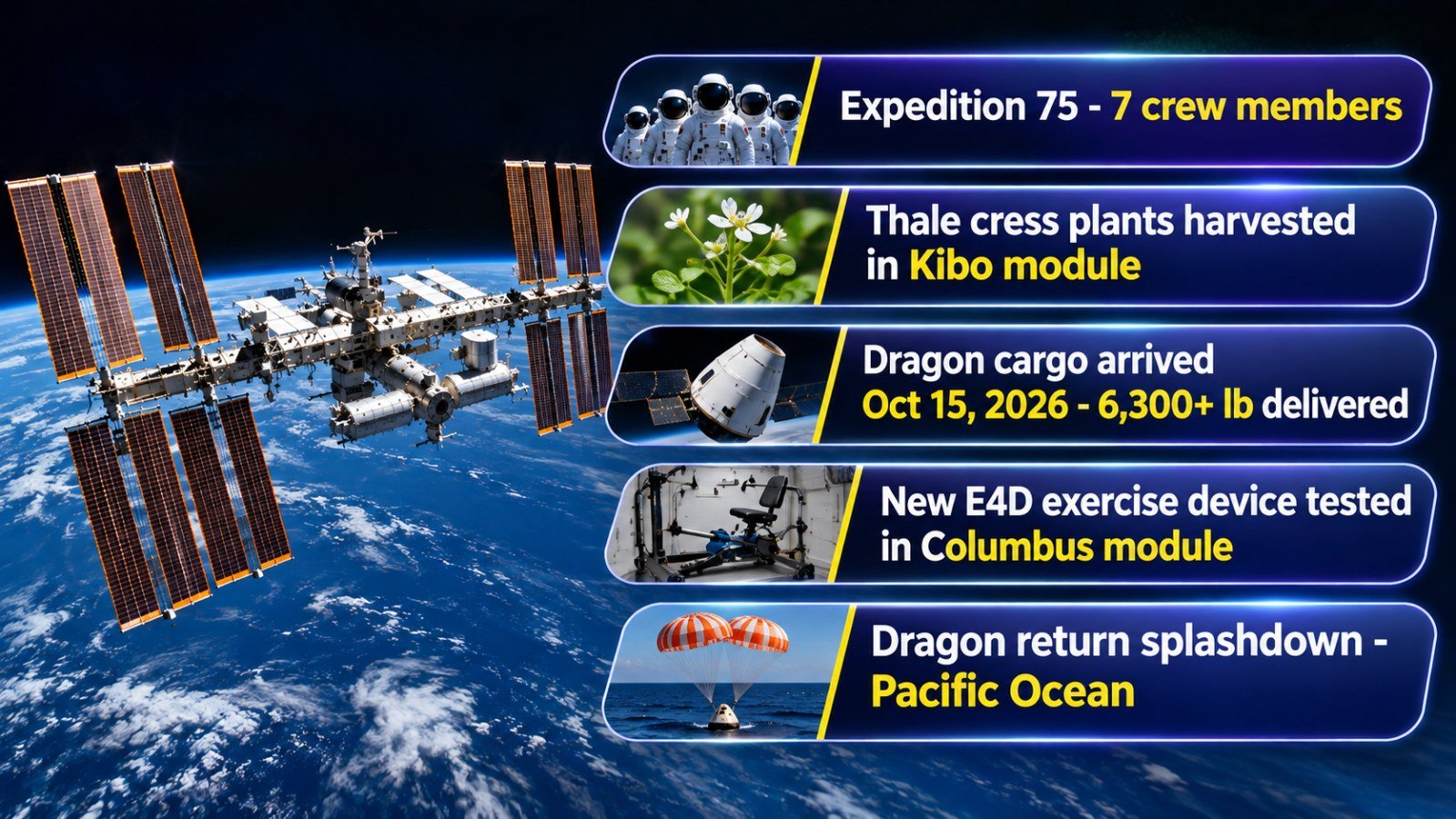
Expedition 75's week at a glance: thale cress harvested in Kibo, Dragon cargo arrived October 15, 2026, and the new E4D exercise device tested in Columbus.
A new exercise machine for deep space
Kutryk's day did not end there. He went on to complete two workout sessions on the European Enhanced Exploration Exercise Device — the E4D — working in the Columbus laboratory module with resistance and rowing movements.
The E4D is a new, compact exercise machine, and researchers want to know whether it can do the job of keeping astronauts' muscles and bones healthy on long missions. That matters more the farther crews travel. In weightlessness, muscle and bone weaken steadily without daily exercise, and a smaller machine that still works well would be a real advantage on a spacecraft heading for the Moon or Mars, where every kilogram and every cubic metre counts.
Packing Dragon for the trip home
Part of Friday was also spent on cargo. The SpaceX Dragon that arrived at the station on October 15, 2026, brought more than 6,300 pounds of science, supplies and roll-out solar arrays. Now Menon and Watkins were working together to pack and secure cargo inside it for the return journey.
Once Dragon leaves the station and splashes down in the Pacific Ocean, NASA and SpaceX teams will recover what it carries. It closes a neat loop: new research and equipment came up a month ago, and finished experiments and samples now head back down for study.
Health checks and a smarter way to report
The station's Russian crew had a full day too. Cosmonauts Pyotr Dubrov and Anna Kikina looked at how super intelligence tools could transcribe crew audio reports, making it easier for mission controllers on the ground to review them. Dubrov also photographed windows inside the Zvezda service module to check their condition.
Kikina measured her blood pressure with arm, wrist and finger cuffs, part of the ongoing effort to understand how spaceflight affects the heart and blood vessels. Flight engineer Sergey Teteryatnikov tested a medical monitoring device by simulating a health check, then sent the results down to doctors on Earth for review.
None of this is dramatic on its own. Taken together, though, it shows how much of station life is now about keeping crews healthy and informed — the unglamorous groundwork that longer missions to the Moon and Mars will depend on.
A vote from orbit
There was one more detail worth noting. A crew photograph from the week shows Delaney, Menon and Watkins wearing "I Voted" stickers after casting their votes in the U.S. midterm elections from orbit. Science filled the week, but ordinary life went on too — even a few hundred miles above Earth.
Frequently asked questions
What did Expedition 75 work on this week?
Space botany and biomedical research, plus packing a U.S. cargo spacecraft for departure.
Why grow thale cress on the station?
Thale cress helps scientists study how space affects plant growth. The findings could support healthier plants on long missions and stronger, more disease-resistant crops on Earth.
What is the E4D?
The European Enhanced Exploration Exercise Device, a new compact exercise machine tested in the Columbus module. Researchers are checking whether it can help maintain muscle and bone health on missions to the Moon, Mars and beyond.
When did the Dragon cargo spacecraft arrive?
Dragon arrived at the station on October 15, 2026, carrying more than 6,300 pounds of science, supplies and roll-out solar arrays.
Where will the returning Dragon cargo land?
Dragon is set to splash down in the Pacific Ocean, where NASA and SpaceX support teams will retrieve the cargo.
Sources
NASA Space Station blog, "Botany, Biomedicine, and Cargo Ops Wrap Up Week Aboard Station" (November 13, 2026, by Mark A. Garcia); NASA Space Station blog, "Spacewalkers Install Final Roll-Out Solar Array" (November 5, 2026).
Related reading on ISS Tracker: ISS Completes Final Solar Array Upgrade: Power Jumps to 215 Kilowatts (https://iss-tracker.net/news/iss-final-solar-array-upgrade-power-215-kilowatts/) · How Does the International Space Station Get Electricity? (https://iss-tracker.net/news/how-does-the-international-space-station-get-electricity/) · How Big Is the International Space Station? (https://iss-tracker.net/news/how-big-is-the-international-space-station/) · Why Doesn't the ISS Fall to Earth? (https://iss-tracker.net/news/why-doesnt-the-iss-fall-to-earth/)