
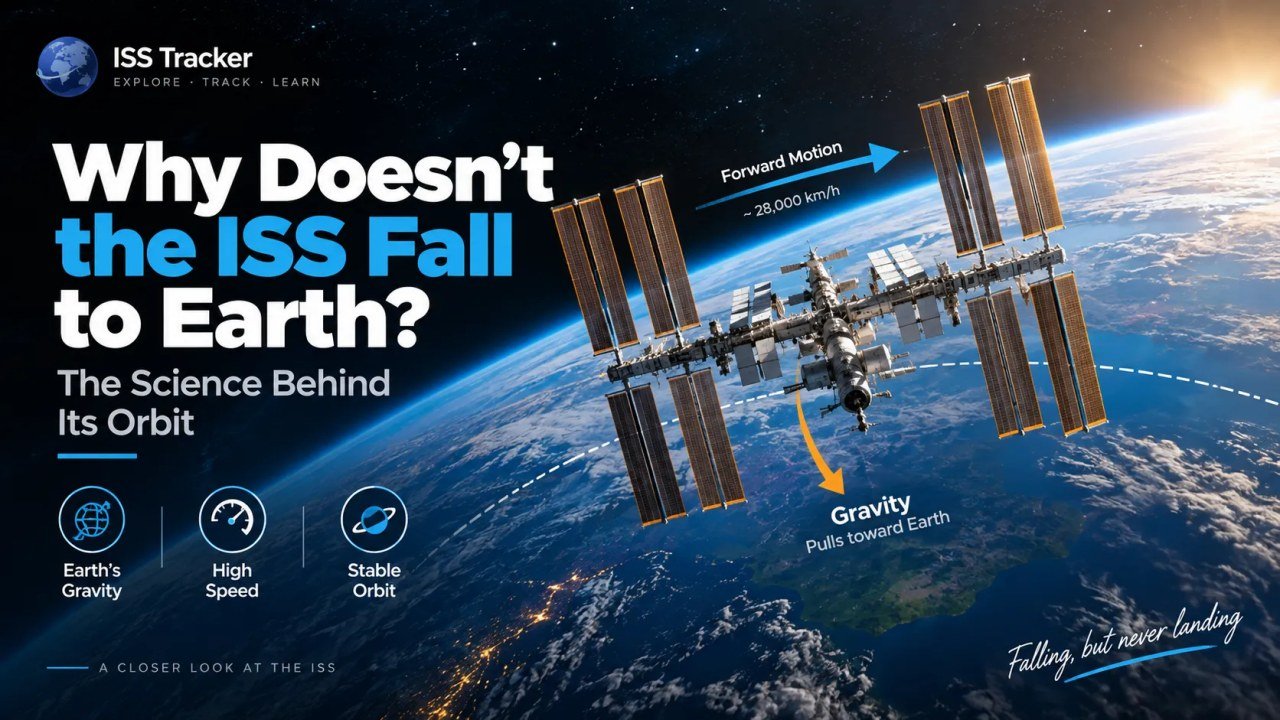
If the International Space Station is constantly being pulled toward Earth by gravity, you might wonder why it never simply drops out of the sky.
The answer is one of the most interesting ideas in space science.
The ISS is falling toward Earth. It just keeps missing the planet.
That may sound strange at first, but it is exactly what happens when an object has the right combination of speed, direction and altitude. The station is moving forward so quickly that while gravity pulls it toward Earth, the curved surface of the planet keeps moving away beneath its path.
This is what creates an orbit.
The ISS Is Not Outside Earth's Gravity
Space does not begin at a point where Earth's gravity suddenly disappears.
The International Space Station orbits Earth at an altitude of roughly 370 to 460 kilometers, and Earth's gravity is still acting strongly at that height.
So why do astronauts appear to float?
It is not because there is no gravity.
The station, its crew and everything inside it are all moving together while continuously falling around Earth. This creates the microgravity environment experienced aboard the ISS.
That distinction is important:
Weightlessness does not mean gravity has disappeared.
So How Does an Orbit Actually Work?
Think about throwing a ball.
If you gently throw it, gravity pulls it down and it lands nearby.
Throw it harder and it travels farther before reaching the ground.
Now imagine being able to throw something so incredibly fast that, while it is falling, the Earth curves away underneath it.
The object keeps falling toward Earth, but it never reaches the surface.
That is the basic idea behind an orbit.
The ISS has enormous sideways velocity. Gravity continually changes the direction of its motion, turning what would otherwise be a straight path into a curved path around Earth.
The result is an orbit rather than a crash.
Why Doesn't the ISS Just Fly Away?
There are two things happening at the same time.
Gravity pulls the ISS inward.
Its forward motion carries it around Earth.
If gravity were suddenly removed, the station would no longer follow its current curved path and would continue along a path determined by its existing motion.
If the station had no sideways orbital velocity, gravity would pull it downward much more directly.
Instead, the two effects work together to produce the path we call an orbit.
This is also why satellites, spacecraft and the Moon can remain in orbit around Earth.
How Fast Does the ISS Travel?
The International Space Station travels at roughly 28,000 kilometers per hour, or about 17,500 miles per hour. At that speed, it completes an orbit in approximately 90 minutes, although the exact orbital period varies with its altitude.
That means the station circles Earth around 16 times during a typical 24-hour period.
For someone watching the ISS from Earth, this enormous speed is one reason the station can cross a large part of the sky during a single visible pass.
Why Do Astronauts Float Inside the ISS?
This is where the idea of free fall becomes useful.
Imagine dropping an object and another object at the same time. If both are affected by gravity in the same way, they fall together.
Inside the ISS, the astronauts and the spacecraft are doing something similar, except their fall continues around the curved Earth instead of ending at the ground.
Because the astronaut and the spacecraft are accelerating together, the astronaut does not feel the normal support force that you experience when standing on Earth's surface.
That is why objects appear to float around the station.
ESA describes this environment as microgravity rather than simply saying that gravity does not exist.
Is the ISS Really in Free Fall?
Yes.
An orbiting spacecraft is essentially in continuous free fall.
But “free fall” does not mean the spacecraft is moving straight downward.
Its initial sideways velocity is extremely important.
The station is continuously being pulled toward Earth, while its forward movement carries it along its orbital path. The combination produces the curved motion around the planet.
A useful way to picture it is:
The ISS is always falling inward, but it is moving forward fast enough to keep going around Earth.
Why Is the ISS So High Above Earth?
The ISS operates in low Earth orbit, hundreds of kilometers above the surface.
Its altitude needs to be high enough for the station to complete its orbit without immediately encountering the much denser atmosphere closer to Earth.
But it cannot simply move into an empty region where atmospheric effects disappear completely.
Even at ISS altitude, there are still extremely thin traces of Earth's atmosphere.
That creates an important problem.
The ISS Actually Does Lose Altitude
The station's orbit is not perfectly permanent.
Tiny amounts of atmospheric particles still exist at its altitude. As the ISS travels through this extremely thin environment at orbital speed, it experiences drag.
The effect is very small moment by moment.
Over time, however, that small amount of drag reduces orbital energy and causes the station's orbit to gradually decrease. NASA explains that this is why the ISS needs periodic orbit-boosting maneuvers.
So the answer to the question “Does the ISS ever fall toward Earth?” is actually yes.
Its orbit naturally gets lower over time.
What Is an ISS Reboost?
A reboost is essentially an orbital adjustment that raises the station's orbit after it has lost some altitude.
Propulsion from suitable spacecraft or station systems can provide the necessary change in motion.
You can think of it as giving the ISS a carefully controlled push to restore part of the orbital energy it has gradually lost.
Without these corrections, the station's orbit would continue to decay.
NASA notes that atmospheric drag is one of the reasons the station requires regular reboosts to remain in orbit.
What Would Happen Without Reboosts?
If the ISS were simply left alone, atmospheric drag would continue to lower its orbit.
As the station descended, it would encounter increasingly significant atmospheric effects.
Eventually, it would no longer be able to remain in its normal orbital environment and would begin its journey back through Earth's atmosphere.
NASA's current ISS information specifically notes that the station cannot remain in orbit indefinitely without orbital maintenance because atmospheric drag naturally causes its orbit to decay.
So the ISS does not stay in space forever just because it is moving quickly.
Its orbit has to be actively managed.
Does the Earth's Atmosphere Exist Where the ISS Flies?
Yes, although it is incredibly thin.
The atmosphere becomes progressively less dense as altitude increases, but it does not suddenly stop at the edge of space.
At the altitude where the ISS operates, the remaining particles are sparse enough that people on the ground would consider the environment almost a vacuum.
For a spacecraft moving at orbital speed, however, even that tiny amount of material matters.
Over long periods, the drag adds up.
This is one of the reasons spaceflight engineers have to continuously monitor the station's orbit.
Why Can't We Just Put the ISS Higher?
Moving the station higher could reduce atmospheric drag, but operating an enormous crewed laboratory is not as simple as choosing a new altitude.
The station's orbit has been selected around many practical requirements, including spacecraft operations, crew transportation, cargo missions and long-term station maintenance.
NASA has also examined different orbital options as part of planning for the eventual end of the ISS program.
For the station's current operations, regular orbital adjustments are a more practical solution than simply moving the entire complex to a much higher orbit.
Does the ISS Have to Fight Gravity?
Not in the way a car fights friction while climbing a hill.
Gravity is actually essential to keeping the ISS in orbit.
Without Earth's gravitational pull, the station would not curve around Earth in the same way.
The important thing is understanding that orbit is a combination of gravitational attraction and motion.
Gravity continuously bends the station's path toward Earth, while its orbital velocity prevents it from simply dropping onto the surface.
That relationship is what makes orbital flight possible.
Why Doesn't the ISS Fall Straight Down?
Because it is not starting from rest.
If you released an object above Earth without giving it enough sideways velocity, gravity would pull it downward.
The ISS already has an enormous amount of horizontal motion.
As it moves forward, gravity changes the direction of that motion.
Instead of following a straight line away from Earth or dropping straight toward it, the station follows a curved path around the planet.
This is the key difference between an object simply falling and an object orbiting Earth.
Why Does the ISS Have a Curved Path?
Earth itself is curved.
The ISS is moving forward while gravity pulls it inward.
Imagine drawing a straight line forward from the station at one moment. Gravity begins bending its trajectory toward Earth.
At the same time, the planet's surface curves away.
The result is a path that keeps the spacecraft circling the planet.
This is why an orbit is not really “floating above Earth.”
It is controlled falling combined with very high-speed motion.
How Does This Affect a Live ISS Tracker?
Once you understand orbital motion, a live ISS tracker becomes much more interesting.
When you see the station moving across a map, it is not simply traveling from one city to another.
The station is following an orbital path around the entire planet.
Its position is constantly changing because the ISS is moving at thousands of kilometers per hour.
A tracker lets you see that movement in real time and understand where the station is in relation to Earth.
You can watch the ISS move across the map while knowing that the spacecraft is simultaneously being pulled toward Earth by gravity.
Why Does the ISS Complete an Orbit So Quickly?
The ISS is moving fast enough to circle Earth in roughly an hour and a half.
That means an astronaut aboard the station can see many sunrises and sunsets during a single day.
The station's orbit also means its path moves relative to locations on Earth's surface as the planet rotates beneath it. NASA's orbital information notes that the station completes an orbit in roughly 90–93 minutes depending on its altitude.
This is one reason the ISS can pass over different regions of Earth throughout the day.
What Is Microgravity?
Microgravity is the condition experienced when objects are in a state of continuous free fall with only very small residual forces acting on them.
The term is sometimes casually described as “zero gravity,” but that can be misleading.
Earth's gravity is still present where the ISS operates.
Instead, the station provides an environment where the effects of gravity are largely masked by the shared free-fall motion of the spacecraft and everything inside it.
This unusual environment is one of the reasons the ISS is valuable for scientific research.
Why Is Microgravity Useful?
On Earth, gravity strongly influences how fluids move, how flames behave, how objects settle and how living organisms develop.
Inside the ISS, many of those familiar effects are greatly reduced.
Scientists can therefore study physical and biological processes under conditions that are difficult to reproduce for long periods on Earth.
Research aboard the station has included areas such as human health, biology, materials, fluid behavior and combustion.
The same orbital environment that makes astronauts appear weightless also creates a unique laboratory for science.
Could the ISS Eventually Return to Earth?
Yes.
The ISS is not designed to remain in orbit forever.
When the station reaches the end of its operational life, its orbit will eventually be lowered in a controlled process rather than allowing a huge spacecraft to simply fall unpredictably.
NASA's current transition planning describes using controlled maneuvers together with natural atmospheric drag to bring the station toward a targeted re-entry over an unpopulated region of the ocean.
That is very different from saying the ISS will suddenly “fall out of the sky.”
Its eventual return will be carefully planned.
The Simple Explanation
So, why doesn't the ISS fall to Earth?
The simplest answer is:
It is falling toward Earth, but it is moving forward so quickly that it keeps traveling around the planet instead of hitting the surface.
Gravity bends its path.
Orbital velocity keeps it moving around Earth.
The result is a continuous orbit.
But that orbit is not completely maintenance-free. Earth's extremely thin upper atmosphere creates drag, slowly reducing the station's orbital energy. Periodic reboosts compensate for that loss and help keep the ISS at its operational altitude.
So the ISS is not “floating” above Earth.
It is falling around Earth.
Watch the ISS Move Around Earth
The next time you open a live ISS tracker and see the station moving across the map, remember what that moving point actually represents.
The ISS is traveling around Earth at roughly 28,000 kilometers per hour.
Gravity is pulling it toward the planet.
Its velocity carries it forward.
The atmosphere is slowly creating drag.
And spacecraft periodically adjust its orbit.
All of these factors work together to keep one of humanity's largest spacecraft circling Earth.
Want to see where the ISS is right now? Open the live ISS tracker and follow its journey around Earth.